The later living sector is one of the most relationship-driven markets in property development — and also one of the most visually underserved. Operators are routinely trying to sell or reserve units in assisted living and retirement schemes that don’t yet exist, to buyers who are emotionally cautious, often unfamiliar with the buying process, and spending life savings. That’s a tough brief. 3D Rendering for Later Living and Retirement Developments: How Operators Are Marketing Assisted Living Schemes Off-Plan has become a serious discipline in its own right, not just a by-product of standard residential CGI workflows. The visual communication needs are fundamentally different, and getting them wrong doesn’t just lose a sale — it erodes trust with a demographic that is difficult to win back.
In our studio, we’ve worked on a range of specialist residential schemes — student accommodation, build-to-rent, healthcare-adjacent facilities — and later living projects sit closest to the healthcare end of that spectrum in terms of how the visuals need to communicate. These aren’t aspirational lifestyle apartments being sold to young professionals. They’re spaces where safety, warmth, community, and dignity all need to come through simultaneously. The architecture can be genuinely excellent, but if the rendering feels cold, institutional, or generic, it immediately undermines the operator’s entire proposition.
The off-plan challenge is also sharper here. Retirement buyers and their adult children — who are often key decision-makers — need to feel confident before construction completes. That means the visual assets have to do the heavy lifting that a show home or site visit normally would. This post breaks down exactly how operators are using 3D rendering to achieve that, what formats work best at each stage, and where most briefs go wrong before the first render is even commissioned.
Why Later Living Schemes Have Unique Visualisation Requirements
Standard residential rendering briefs focus on space, light, and aspiration. Later living briefs require all of that, plus an additional layer: believability of use. A prospective resident or their family isn’t just asking “does this look nice?” — they’re asking “can I see myself actually living here?” That’s a much higher bar.
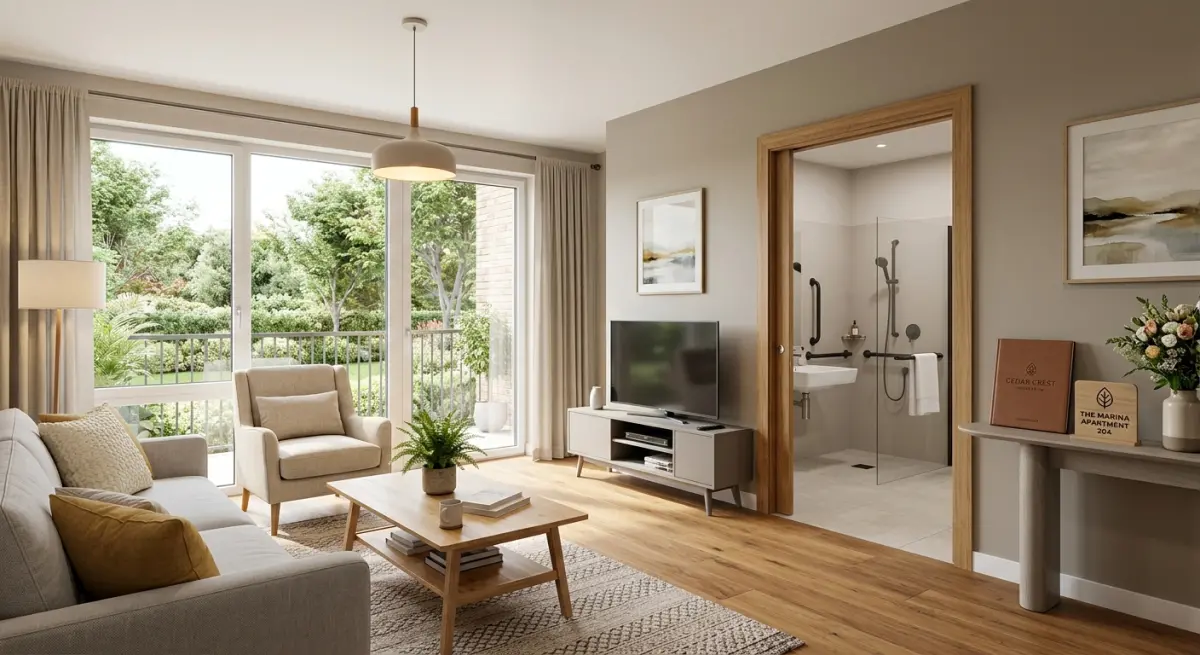
What this means in practice is that every interior render needs to show evidence of real habitation, without looking cluttered or chaotic. Lifestyle props matter enormously — books on a side table, a cardigan on an armchair, a mug next to a reading lamp. These details signal that the space is designed for comfort and independence, not institutional efficiency. We spend considerably more time on soft furnishing and prop selection for later living briefs than we do for comparable apartment renders.
Accessibility features need to appear naturally within the design, not as afterthoughts bolted onto an otherwise generic interior. Wide doorframes, lever handles, walk-in shower enclosures, and clear turning circles should be visible in the renders — and they should look like considered design choices, because that’s what good operators do. Hiding these elements in the CGI to make the space look more “normal” is one of the biggest mistakes we see. Buyers in this market are often specifically looking for those features; not showing them creates uncertainty rather than reassurance.
Communal spaces are also critical in a way they simply aren’t in standard BTR or for-sale residential. A well-rendered lounge, dining room, landscaped courtyard, or wellness space can be the deciding factor in an enquiry converting to a reservation. These aren’t amenity add-ons — they’re the core product proposition of any good later living scheme.
3D Rendering for Later Living and Retirement Developments: The Off-Plan Marketing Stack
Operators marketing assisted living schemes off-plan typically need a layered suite of assets, not a single hero image. The buyer journey is longer and more considered than in standard residential, and different visual formats serve different stages of that journey.
Stage One: Generating Awareness and Initial Enquiry
At the top of the funnel, operators need broad-reach assets that communicate the character and location of the scheme. This is where exterior renders and aerial views do most of the work. A high-quality residential exterior rendering showing the building in its landscaped setting — mature planting, appropriate weather conditions, a few figures to suggest human scale — gives a scheme its visual identity before construction begins.
Aerial perspectives are particularly useful for later living schemes because they show the relationship between the building and its surroundings: proximity to green space, distance from the town centre, access routes. For a retirement buyer, context matters as much as the building itself. An aerial 3D rendering communicates all of this in a single image in a way that a ground-level exterior render simply can’t.
At this stage, the detail level doesn’t need to be hyper-precise — operators are often working from planning drawings rather than full construction packages. Understanding what level of architectural detail do you actually need in a 3d rendering lod 100 to lod 400 explained for developers helps operators avoid over-commissioning at this stage and under-commissioning later.
Stage Two: Nurturing Serious Enquiries
Once a prospective buyer has registered their interest, the visual assets need to do much more detailed work. This is where interior renders of apartments, communal areas, and outdoor spaces become essential. The goal is to help the buyer — and often their adult children — feel emotionally connected to a space they haven’t visited.
Interior renders of the apartment itself should cover multiple rooms and multiple lighting conditions. A living room in warm afternoon light reads very differently to the same space at dusk, and later living buyers are acutely sensitive to how a space will feel at different times of day. Lighting simulation in renders is genuinely important here.
360 virtual tour rendering vs matterport scans which works better for offplan property sales is a question we get asked regularly in this sector. For later living, interactive 360 tours are especially powerful because they allow buyers to explore at their own pace, revisit spaces they’re uncertain about, and share the experience with family members who might be in a different city. A physical show suite is still valuable, but an interactive render makes the equivalent of that show suite available 24 hours a day to anyone with a tablet or laptop.
Stage Three: Supporting Reservation and Exchange
At the point of reservation, buyers need clarity and specificity. This is where 3D floor plan rendering becomes genuinely useful. A three-dimensional floor plan helps a buyer understand how their existing furniture might fit, where the natural light comes from, and how the layout actually functions — things a 2D drawing simply doesn’t communicate to a non-technical audience.
For operators running sales from a marketing suite rather than a completed show home, a well-produced animation walking through key spaces can be the closest thing to a site visit available. Understanding animation vs static renders for property developer sales brochures which format converts better at each stage of the funnel helps operators decide where animation budget is actually justified rather than just impressive.
What Later Living Renders Must Get Right: Technical Observations
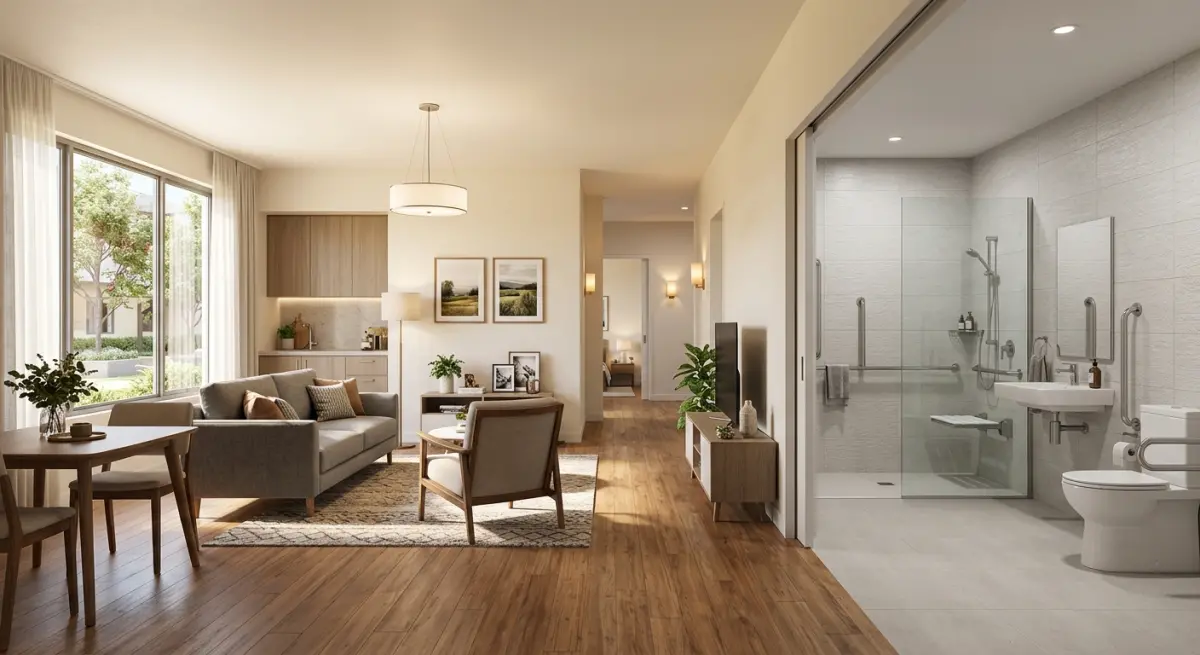
Several technical decisions in the rendering process make a significant difference to how these visuals land with the target audience.
| Element | Common Mistake | What Actually Works |
|---|---|---|
| Lighting | Cool, blue-tinted daylight that reads as clinical | Warm, layered light — ambient plus accent — that reads as residential and welcoming |
| Furniture scale | Oversized contemporary furniture that makes the space feel younger | Appropriately scaled, comfortable pieces with higher seat heights and supportive silhouettes |
| Human figures | Generic 30-something figures that don’t match the target demographic | Age-appropriate figures in communal spaces, showing social activity without stereotyping |
| Exterior landscaping | Generic planting that looks like any apartment block | Established planting, accessible pathways, seating areas that signal a garden designed for use |
| Material palette | Ultra-glossy surfaces that feel hard and institutional | Matte textures, warm timbers, and soft neutrals that communicate comfort and tactility |
Lighting is the most technically consequential of these. The difference between a render that feels warm and one that feels clinical often comes down to colour temperature, shadow softness, and the balance between ambient and task lighting. We almost always render later living interiors with multiple light sources rather than relying on daylight alone, because that’s how the spaces actually function — and because the warmth of interior lighting is a powerful emotional signal in this context.
Working With Planning Requirements and Consent-Stage Renders
Many later living operators are commissioning renders while a scheme is still at planning application stage. This creates its own set of constraints. Planning visualisations need to be accurate to the proposed design and contextually honest — they can’t omit neighbouring buildings, misrepresent the building’s relationship to street level, or show landscaping that isn’t approved. Marketing renders have more creative latitude, but the gap between the two can trip up operators who don’t understand where the boundaries are.
We’ve found it helpful to separate the planning visualisation brief from the marketing brief entirely, even when they draw on the same base model. The planning committee wants accuracy and context. The marketing audience wants warmth and vision. Both are legitimate — they just require different decisions at the rendering stage.
For schemes that need to demonstrate how natural light will reach key spaces — particularly important for later living given the health benefits of daylight for older residents — accurate sun studies can support both planning and marketing goals simultaneously. The technical approach behind this is worth understanding: daylight simulation in architectural rendering how accurate sun studies are helping developers beat planning objections covers this in detail.
What Operators Get Wrong When Briefing for Later Living Renders
The most consistent problem we see is operators treating later living renders as a subset of standard residential. They send us the same brief they’d send for a standard apartment scheme — hero exterior, three interior views, one aerial — and wonder why the results feel generic when applied to their later living product.
The communal spaces are almost always underserved. An operator might commission a beautiful apartment render and then skip the lounge, the dining room, and the landscaped garden entirely. But for a retirement buyer, those communal spaces are often the primary reason for choosing one scheme over another. They need renders too, and often more than one view per space.
Another recurring issue is over-specifying the exterior render at early stage when the money would be better spent on interior and lifestyle content. Exterior renders for later living do important work, but they’re rarely the thing that converts an enquiry into a reservation. That conversion happens when a buyer can imagine living in the apartment — eating breakfast at the kitchen table, sitting in the communal lounge with neighbours, walking around the garden. Invest accordingly.
Budget allocation is a real consideration. If you’re not sure where to start when thinking about render packages for a later living scheme, reviewing how much does architectural rendering cost in 2026 a developer8217s pricing breakdown is a useful starting point before briefing a studio.
Conclusion
Later living and assisted living developments present one of the most considered and emotionally nuanced briefs in property visualisation. The stakes for buyers are high, the decision-making process is slow, and the visual assets have to compensate for the absence of a completed building across an extended sales campaign. Generic renders produced to a standard residential template won’t do the job. The lighting, the furniture, the communal spaces, the lifestyle figures, the accessible design features — all of it needs to be thought through with the specific buyer in mind.
The operators getting this right are treating visualisation as a core part of their marketing strategy, not an afterthought. They’re commissioning in layers, matching the asset type to the buyer journey stage, and briefing studios with the same precision they’d apply to any other part of their sales process. If you’re working on a later living scheme and want to talk through what a proper visualisation package looks like — from planning renders through to interactive tour content — contact us at 360archviz.com. We work with operators across the later living sector and understand exactly what this audience needs to see before they’ll commit.
Frequently Asked Questions
What is 3D rendering and how is it used to market assisted living developments off-plan?
3D rendering is the process of creating photorealistic digital images or animations of a building before it has been physically constructed, allowing developers to showcase assisted living schemes to prospective residents and investors at the earliest stages of a project. For later living operators, this means producing highly detailed visuals of interiors, communal spaces, landscaped gardens, and accessibility features that help buyers emotionally connect with a property that does not yet exist. Off-plan marketing using 3D renders has become standard practice in the retirement sector, enabling operators to secure reservations, attract funding, and generate waitlists long before construction completes.
Why are 3D renders particularly effective for marketing retirement and assisted living communities?
Retirement and assisted living buyers are making one of the most significant lifestyle decisions of their lives, and 3D renders help bridge the gap between abstract floor plans and the warm, welcoming environment they are hoping to move into. High-quality visuals can convey specific details that matter deeply to this demographic, such as wide corridors for mobility aids, wet rooms, sensory gardens, dining experiences, and staff interaction areas, all of which build confidence and trust in the development. Research consistently shows that emotionally resonant visuals accelerate decision-making, reduce buyer hesitancy, and lead to higher off-plan reservation rates compared to traditional marketing materials alone.
How much does 3D rendering cost for a later living or assisted living development?
The cost of 3D rendering for a later living scheme can vary significantly depending on the scope of the project, ranging from approximately £500 to £2,000 per still image for individual apartment or communal space renders, and rising to £10,000–£50,000 or more for full CGI animation walkthroughs or large-scale masterplan visualisations. Factors influencing the price include the complexity of the architecture, the level of photorealistic detail required, the number of scenes or render angles needed, and whether drone-style aerial views or virtual tour experiences are included. Many operators find the investment highly justified given that a single off-plan reservation in a retirement development can represent hundreds of thousands of pounds in revenue.
What types of 3D renders do retirement development operators typically commission for off-plan marketing?
Operators of assisted living and retirement communities typically commission a combination of exterior CGIs showing the building façade and landscaping, interior lifestyle renders depicting living rooms, kitchens, bathrooms, and communal dining areas, and amenity space visuals covering features like wellness suites, libraries, or cinema rooms. Many also invest in 360-degree virtual tours and animated walkthrough videos that can be embedded on sales websites or presented at show home exhibitions, helping prospective residents explore the development remotely. Increasingly, developers are also using CGI-enhanced site plans and aerial masterplan views to contextualise the scheme within its surrounding community and demonstrate proximity to local amenities.
How can 3D rendering help operators sell assisted living units off-plan faster and reduce vacancy risk?
By presenting a fully realised, visually compelling version of a development before construction begins, 3D rendering allows sales teams to open reservations much earlier in the development timeline, effectively reducing the period between completion and full occupancy. High-quality renders used across brochures, digital advertising, social media, and show suite presentations create a consistent and aspirational brand narrative that resonates with older buyers and their adult children who are often involved in the decision. Operators who invest in professional CGI packages typically report shorter sales cycles, stronger pre-launch inquiry volumes, and reduced reliance on discounting or incentive packages to fill units post-completion.