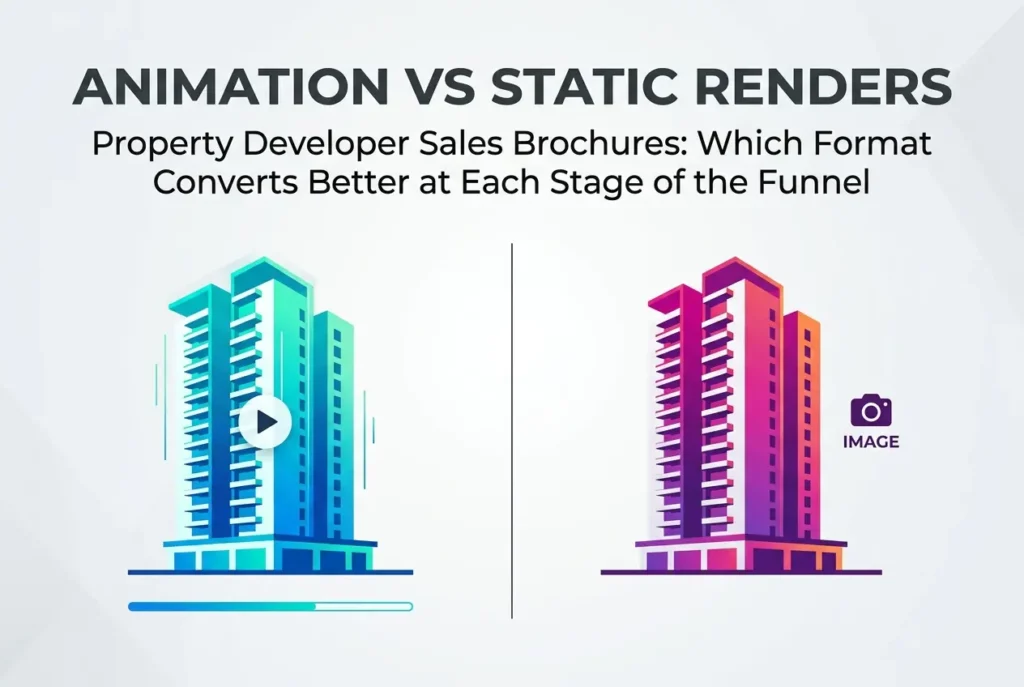
One of the most common questions we get from property developers preparing sales brochures is whether animation vs static renders for property developer sales brochures — which format converts better at each stage of the funnel — is even the right question. Most developers frame it as a budget decision. “Can we afford animation?” or “Are static images enough?” But the real question is strategic: which format is doing the right job at the right moment in the buyer’s decision journey? Get that wrong and you’re spending money on the wrong asset, at the wrong time, for the wrong audience.
We’ve worked on sales brochure assets across residential towers, mixed-use schemes, build-to-rent blocks, and boutique apartment developments. The pattern we see repeatedly is that both formats work — but for different reasons, at different funnel stages. Neither is universally superior. An animation shown too early in the funnel can overwhelm a prospect who hasn’t yet emotionally committed to the project. A static image shown at the point-of-sale stage can feel flat when a buyer needs to feel the space before signing. Context matters enormously.
This post breaks down how to think about format selection strategically — not as a luxury vs economy decision, but as a communication design decision. Whether you’re putting together a brochure pack for an off-plan launch, a hoarding campaign, a digital ad funnel, or an investor deck, what follows should help you allocate your visual budget where it actually moves people forward.
Understanding the Funnel Before You Choose a Format
Property sales funnels aren’t monolithic. A typical buyer journey moves through awareness, consideration, evaluation, and commitment. Each stage has a different psychological profile. At awareness, people are scanning — they’re not ready to absorb detail, they’re looking for a reason to pay attention. At consideration, they’re comparing and imagining. At evaluation, they’re stress-testing the decision, looking for reassurance. At commitment, they need conviction.
Animation and static renders serve these stages very differently. Static images are fast to process. A single well-composed hero exterior shot can communicate quality, location context, and architectural character in under three seconds. That’s exactly what you need at the awareness stage — in digital ads, on hoardings, on the cover of a brochure. Animation requires time and attention. A 90-second flythrough assumes the viewer is already engaged enough to sit and watch. That’s consideration-stage behaviour, not awareness-stage behaviour.
This is the lens through which every format decision should be made.
Where Static Renders Win in a Sales Brochure
Static renders dominate at the top and bottom of the funnel. At the top, they’re the hook. At the bottom, they’re the closer. Here’s why.
For the brochure cover and hero spread, a single photorealistic exterior render sets the entire emotional tone of the project. It establishes lifestyle aspiration, material quality, and neighbourhood context in one frame. We spend a significant amount of our brief-taking time on hero shots because they carry more persuasive weight per pixel than anything else in a brochure. The angle, lighting time-of-day, entourage choices — every decision compounds. A well-lit golden-hour hero shot with the right human scale figures and landscaping reads as premium in a way that no animation frame can replicate, because the still image lets the eye dwell.
Interior statics work the same way on individual unit pages. A bedroom render, a kitchen render, a bathroom close-up — these are the images buyers return to after reading the brochure. They’re the images buyers text to their partners. They’re making a specific promise: “this is what your life could look like here.” You can read more about how this plays out practically in how residential developers use interior renderings to sell off-plan properties before construction starts.
At the bottom of the funnel — at a sales suite conversation, or when a buyer is reviewing the pack before reserving — static renders work because they’re referenceable. A buyer can point at a printed image. They can annotate it, pin it, come back to it. Animation doesn’t offer that. You can’t flip back to a timestamp in a video the way you can turn a page.
Where Animation Converts Better — and When to Deploy It
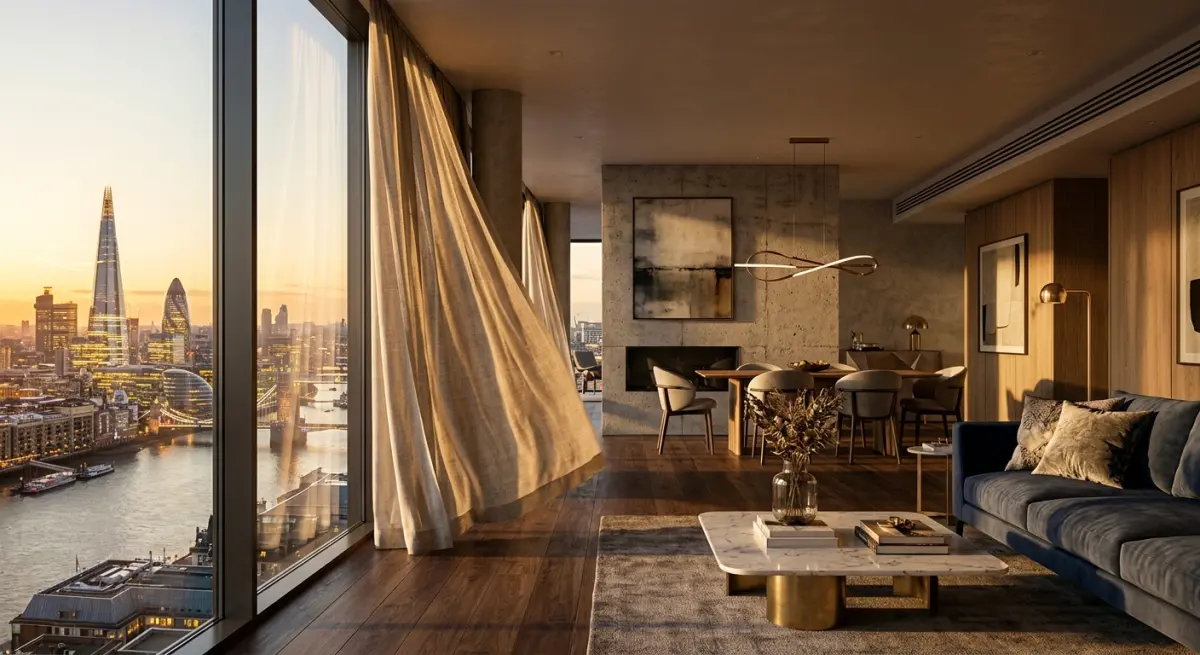
Animation earns its budget in the consideration and evaluation stages. This is when buyers are actively comparing options, and when the development still needs to communicate something that static images can’t fully capture — spatial flow, scale, the relationship between spaces, the journey from entrance to amenity to unit.
A 3D walkthrough animation does something no static image can: it shows sequence. Walking from a lobby into a corridor, into a lift lobby, into a living room, out onto a balcony — that sequence builds spatial memory. Buyers start to feel ownership of the space before they’ve visited it. That’s powerful at the consideration stage, particularly for off-plan sales where no physical product exists yet.
Flythroughs serve a slightly different purpose — they show massing, context, and masterplan. For a mixed-use scheme or a large residential development, a flythrough helps buyers understand where their building sits within a wider place. That’s a different kind of reassurance to interior statics, but equally important for certain buyer profiles. If you’re unclear on which animation format to use, the breakdown in 3d walkthrough vs 3d flythrough which presentation format wins more real estate approvals goes into the distinctions clearly.
Where animation has the highest conversion impact is in digital sales channels — landing pages, social media campaigns, email sequences to registered leads. A short 30–60 second edit on Instagram or in a targeted Facebook campaign reaches buyers in their consideration phase far more effectively than a static post. The autoplay dynamic means you get emotional engagement without the viewer having to commit to a click.
Animation vs Static Renders for Property Developer Sales Brochures: A Practical Format Guide by Funnel Stage
| Funnel Stage | Buyer Behaviour | Recommended Format | Typical Use Case |
|---|---|---|---|
| Awareness | Scanning, fast decisions | Static exterior render | Hoardings, OOH, social ads, brochure cover |
| Consideration | Comparing, imagining | Animation (walkthrough or flythrough) | Landing page hero, email to registered leads, social video |
| Evaluation | Stress-testing the decision | Static interiors + 360 virtual tour | Brochure unit pages, sales suite screens, digital brochure |
| Commitment | Seeking final reassurance | Static renders + floor plan renders | Reservation pack, legal documents, printed brochure |
Note how the evaluation stage benefits from interactive formats. A 3d 360 virtual tour rendering sits between static and animation — it gives buyers the spatial experience of animation with the on-demand control of a static. For buyers who want to “walk the flat themselves” before visiting a sales suite, interactive tours are often more convincing than a linear walkthrough video, because control builds confidence.
What Developers Get Wrong About Format Selection
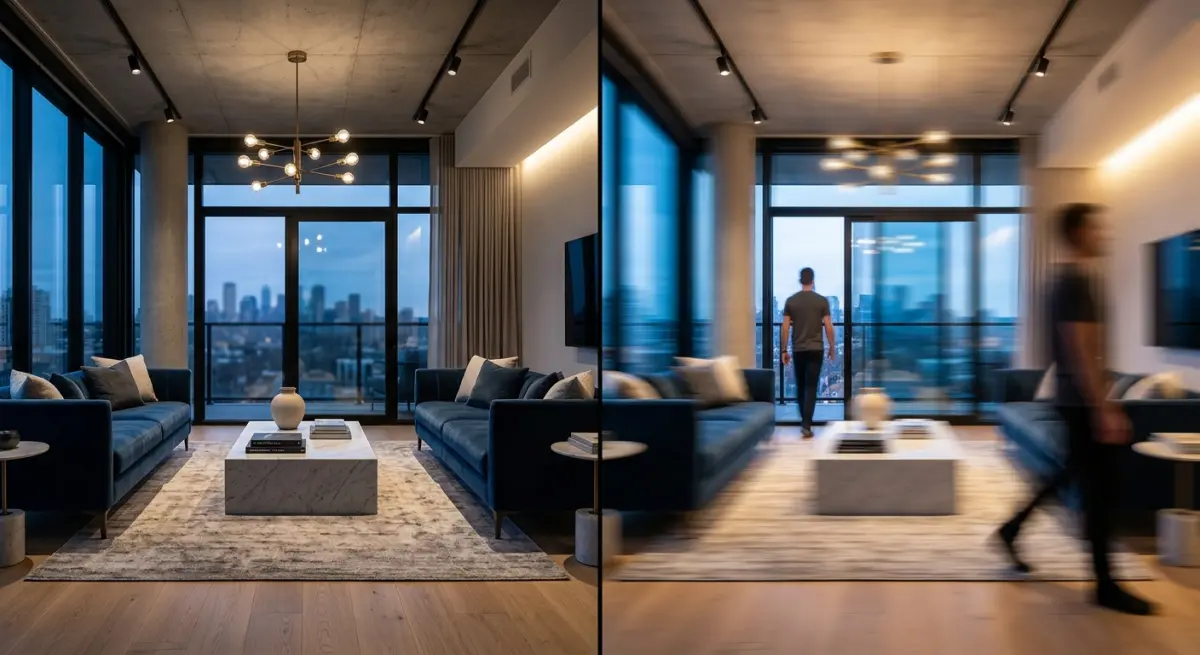
The most common mistake we see is treating animation as an upgrade to static rather than a different tool entirely. Developers often commission a full 90-second walkthrough animation for a brochure that primarily gets printed and handed out at property exhibitions. A printed brochure cannot play video. The animation exists as a separate asset that doesn’t integrate with the brochure itself — and yet the budget for it came at the expense of additional static hero shots, floor plan renders, or interior views that would have done far more work inside those pages.
The second mistake is producing animation too early in the design process. Animation takes longer to revise than statics. If the design is still evolving — materials changing, layouts shifting — committing to an animated sequence locks in details that may need to change. In our studio, we generally recommend completing all design-stage static approvals before starting animation production. It’s a sequencing discipline that saves significant rework cost. If you want to understand the full production timeline implications, how long does architectural 3d rendering actually take a project-by-project turnaround guide lays it out clearly.
The third mistake is assuming buyers want more content rather than better content. A brochure with twelve interior statics of varying quality is less persuasive than one with four exceptional ones. Same logic applies to animation — a tight 45-second edit with strong pacing and thoughtful camera moves converts better than a bloated three-minute tour with padding. Editing discipline is part of the production value.
Budget Allocation: How to Split Between Animation and Statics
There’s no universal ratio, because it depends on your sales channel mix and your target buyer profile. But here’s how we typically think about it with clients.
If the primary sales channel is a physical sales suite, printed brochure, and property exhibition, then static renders should take the majority of the visual budget. You need a strong hero exterior, three to five interior views, a CGI site context image, and rendered floor plans. These are the assets your buyers will engage with most directly. Animation can supplement — a looping screen in the sales suite, a short social clip for launch week — but it shouldn’t dominate the spend.
If the primary sales channel is digital — a dedicated landing page, social advertising, email campaigns to a registered interest list — then the balance shifts meaningfully toward animation and interactive formats. A 30-second social-first edit, a 360 virtual tour embed on the landing page, and a handful of static stills for ads gives you coverage across the full digital funnel.
For investor-facing brochures specifically, the format logic shifts again. Investors are evaluating yield, location, and project credibility — not lifestyle aspiration. Here, a clean photorealistic exterior, accurate site context, and clear 3d floor plan rendering will often do more work than animation. Investors process information analytically. The formats that support analytical decision-making — statics, floor plans, aerial context views — align with that. If you’re targeting PBSA investors or institutional buyers specifically, 3d rendering for student accommodation developments what PBSA investors and university partners need to see at pre-approval stage covers the format expectations in that segment in detail.
The Format That Bridges Both Worlds
One format that doesn’t get enough attention in this conversation is the cinemagraph — a hybrid still/animation where a single photorealistic interior or exterior render has one looping element (curtains moving, water reflecting, steam rising from a coffee cup). It carries the emotional impact of a still while introducing motion that catches the eye in digital contexts. For digital brochure PDFs, landing page headers, and social content, cinemagraphs can perform exceptionally well. They’re cheaper to produce than full animation, don’t require a narrative arc or scripted camera path, and don’t demand three minutes of a viewer’s attention.
We’ve used them effectively on apartment launch campaigns where the developer wanted something more dynamic than a static for digital but couldn’t justify the timeline or cost of a full walkthrough animation at that stage of the sales programme.
Final Thoughts and What to Do Next
The question of animation vs static renders for property developer sales brochures isn’t answered by format preference — it’s answered by funnel mapping. Know where your buyers are in their decision journey when they encounter each asset. Match the cognitive demand of the format to the attention your buyer is ready to give at that moment. Use statics to hook, animate to engage, and return to statics to close.
If you’re planning a sales brochure visual package for an upcoming development and want to think through which formats belong at which stage of your specific funnel, contact us at 360archviz.com. We’ll look at your sales channel mix, your buyer profile, and your timeline — and give you a format recommendation that actually maps to conversion rather than just producing assets because that’s what was done last time.
Frequently Asked Questions
Do animated property renders convert better than static images for off-plan apartment sales?
Animated property renders typically outperform static images for off-plan apartment sales during the awareness and consideration stages, where buyers need help visualising unbuilt spaces. Studies in real estate marketing show that listings with video or animation content receive up to 403% more enquiries than static-only listings. However, high-quality static renders often close deals more effectively at the decision stage, where buyers want to scrutinise finishes, materials, and spatial detail at their own pace.
At which stage of the property sales funnel should developers use animation versus static renders?
Animation works best at the top of the funnel for generating awareness and emotional engagement, particularly on social media, developer websites, and digital advertising campaigns where attention spans are short. Static renders are more effective mid-funnel in brochures, sales suites, and email nurture sequences where prospects are comparing developments and need detailed visual information. At the bottom of the funnel, during reservation and contract stages, static renders paired with interactive floor plans tend to support confident purchase decisions better than animation alone.
How much does property animation cost compared to static renders for a sales brochure?
Static CGI renders for a property development typically cost between £300 and £1,500 per image depending on complexity, scene detail, and the studio used, making a full brochure set of 10 to 15 images a manageable investment for most developers. Architectural animation walkthroughs range from £3,000 to £25,000 or more depending on duration, level of detail, and whether aerial drone-style sequences are included. Developers should weigh this cost against the sales funnel stage they are targeting, since animation delivers the highest ROI when used for lead generation rather than late-stage conversion.
Can property developers use both animation and static renders together in a sales brochure without confusing buyers?
Yes, combining both formats in a cohesive sales brochure is considered best practice by leading property marketing agencies, provided there is a clear visual hierarchy that guides the buyer journey. A common approach is to open the brochure or digital presentation with a short animation or embedded QR code linking to a walkthrough, then transition to static renders for detailed apartment layouts, material boards, and lifestyle imagery. This hybrid approach caters to different buyer preferences and decision-making styles without creating visual inconsistency, as long as the CGI style and lighting remain consistent across both formats.
Which format performs better for property developer social media advertising, animation or static renders?
Short-form animation and video content consistently outperforms static renders on social media platforms like Instagram, Facebook, and LinkedIn for property developer advertising, primarily because algorithms favour video content and users stop scrolling for movement. Meta's own advertising data shows video ads generate 20 to 30 percent lower cost-per-click compared to static image ads in the real estate category. However, static renders used in carousel ads or as supporting creative in retargeting campaigns can effectively re-engage warm leads who have already watched an animation and are now evaluating specific unit types or finishes.

1 comment