
When developers ask us about 360 Virtual Tour Rendering vs Matterport Scans: Which Works Better for Off-Plan Property Sales, the answer almost always surprises them. Most people assume these two tools are interchangeable — that they both show buyers a space in an immersive way and achieve roughly the same result. But from where we sit, working with developers and architects across residential and commercial projects every week, the difference is fundamental. It’s not just a technical distinction. It changes what a buyer feels, what a developer can sell, and critically — what’s even possible before a single brick is laid.
Matterport is a scan-based technology. It captures physical spaces that already exist. A camera rig moves through a completed room, stitches together a point cloud of real geometry, and outputs a navigable dollhouse model. It’s genuinely impressive for what it is. But here’s the problem: off-plan property doesn’t exist yet. You can’t scan something that hasn’t been built. So right away, Matterport is out of the running for the most important window in a developer’s sales cycle — that pre-construction phase where you need to generate reservations, attract investor interest, and build cash flow before the foundations are even poured.
That’s where 3D 360 virtual tour rendering comes in. This is a fully CGI-built experience, constructed from architectural drawings, specifications, and material schedules. No physical space required. The result can be indistinguishable from a scan of a real room — except that it shows a space that won’t exist for another 18 months. That distinction is worth exploring in depth.
What Matterport Actually Does — and Where It Falls Short
Matterport works beautifully in the right context. Estate agents use it to create virtual viewings for completed homes. Hospitality groups use it to show hotel rooms to corporate bookers. Museums use it for remote access experiences. In all these cases, there’s a real, finished space to capture.
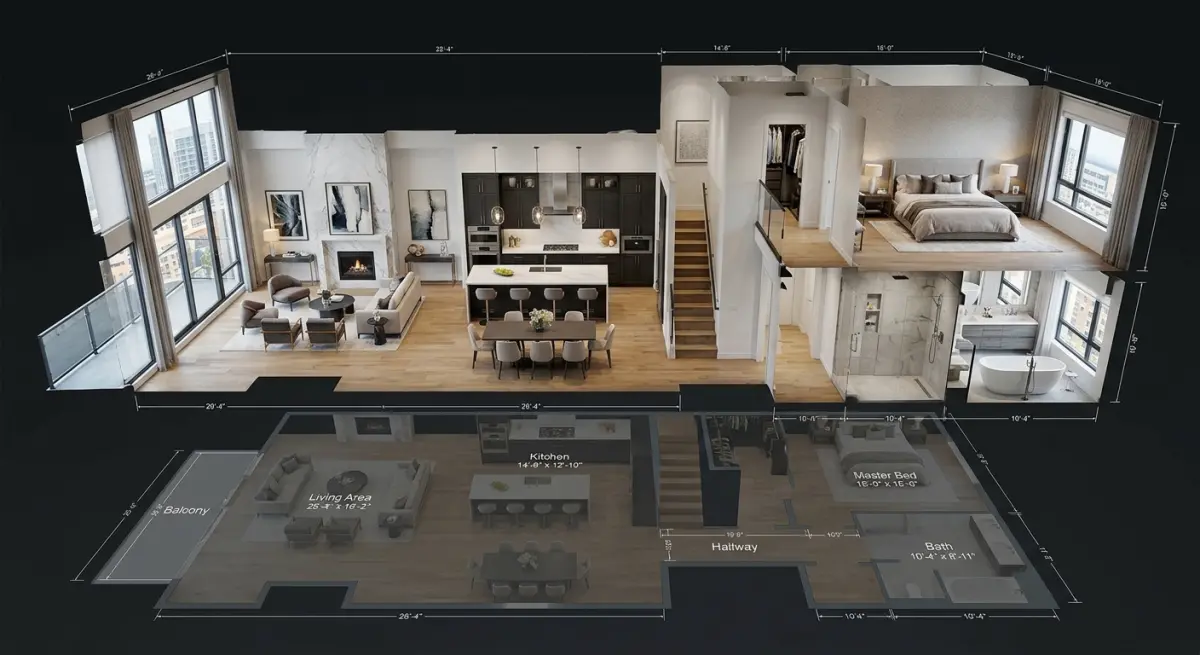
The output is a navigable 3D scan with hotspots, floor plan overlays, and a dollhouse view that lets users orbit the entire property from above. The data is dense. The interaction feels fluid. And because it’s based on actual geometry, everything is spatially accurate — the skirting boards, the ceiling height, the distance between the island and the kitchen units. What you see is genuinely what exists.
But for off-plan sales, this is precisely the wrong tool. A developer launching a 40-unit apartment scheme six months before planning consent won’t have a showroom to scan. And even if they build a show home later, they’ll have already missed the early-bird phase where pricing is most favourable and investor momentum is built. By the time Matterport becomes viable, the most critical sales window has closed.
There’s also a creative limitation worth mentioning. Matterport captures what’s there — not what could be there. If you want to show a premium finish, a specific furniture layout, or a kitchen scheme that hasn’t been fitted yet, you can’t do it with a scan. Renders give you control over every material, every light source, and every decorative decision. That level of control is commercially valuable.
360 Virtual Tour Rendering vs Matterport Scans: Which Works Better for Off-Plan Property Sales
Let’s be direct about this. For off-plan, CGI-rendered 360 tours win on nearly every relevant dimension. Here’s how the two compare across the factors that matter most to developers:
| Factor | 360 Virtual Tour Rendering (CGI) | Matterport Scan |
|---|---|---|
| Requires completed space | No — works from drawings | Yes — must exist physically |
| Usable at pre-construction stage | Yes | No |
| Material and finish control | Full — any spec, any colour | Limited to what was built |
| Lighting control | Complete — time of day, mood | Captures ambient light only |
| Multiple unit types from one shoot | Yes — all unit types from drawings | Only what’s been built |
| Upgrade/option visualisation | Yes — multiple finish packages | Not without re-scanning |
| Online embeddability | Yes | Yes |
The practical implication is straightforward. If you’re selling properties before they’re built — and that’s the definition of off-plan — you need rendered 360 tours. Full stop. If you’re an agent selling a completed home or a landlord marketing an existing commercial unit, Matterport is a faster and often cheaper option for that specific use case.
How Rendered 360 Tours Are Actually Built

A common misconception is that 360 virtual tour rendering is just a series of still images stitched together. It’s more than that. We build a complete 3D model of the interior — every wall, ceiling profile, cornice detail, kitchen unit, and window reveal. We apply physically based materials: real wood grain with proper roughness values, polished concrete with correct reflectivity, glazed tiles with accurate specularity. Then we light the scene with a combination of HDRI environments, IES photometric data from real luminaires, and carefully placed emitters to simulate artificial lighting.
Each 360 node is a fully rendered equirectangular image, typically rendered at very high resolution so that when a buyer drags the view around on their phone or desktop, the quality holds up. We place multiple nodes through the apartment — hallway, living space, kitchen, master bedroom, bathrooms — and connect them with navigation hotspots. The result feels like moving through a real space, even though that space is months away from completion.
The production pipeline is detailed work. If you’re curious about timelines, our post on how long does architectural 3D rendering actually take a project-by-project turnaround guide breaks down what’s involved and what affects delivery time depending on project complexity.
What Developers Actually Get Wrong About This Choice
A few misconceptions come up regularly in our conversations with clients.
Misconception 1: “We’ll use Matterport when the show home is ready.” This is the most common. Developers plan to build a physical show home, scan it, and use that for sales. But show homes take time and money. By the time it’s finished and scanned, the prime sales period may have passed. We’ve seen projects where a rendered 360 tour, delivered from drawings, allowed sales to begin months earlier — before a physical show home existed at all. The people buying off-plan typically want to be in early. Make it easy for them to commit early.
Misconception 2: “CGI looks fake compared to a real scan.” This used to be true. It isn’t anymore. High-quality interior rendering has reached a level where the average buyer cannot reliably tell a rendered image from a photograph. What does look obviously fake is low-quality CGI — and that’s a budget issue, not a technology issue. If you want to understand what separates believable renders from obviously fake ones, our breakdown of what makes a commercial exterior rendering look photorealistic lighting materials and context explained covers the key principles that apply equally to interior work.
Misconception 3: “We only need the tour for one unit type.” This is leaving money on the table. If a scheme has one-bed, two-bed, and penthouse units, each at a different price point, buyers of each unit type need to visualise their specific apartment. The incremental cost of building additional unit tours from an already-constructed 3D scene is considerably lower than the first unit. We recommend covering at least the key unit types and, where possible, showing alternative finish packages — this mirrors how housebuilders have started thinking about 360 virtual walkthroughs for show homes why housebuilders are replacing physical showhomes with interactive renders.
Where Matterport Still Has a Role
It would be unfair to dismiss Matterport entirely. There are situations where it genuinely makes sense, even in a developer context.
If you’ve completed a phase of development and want to keep marketing the remaining units using the actual finished apartments as visual references — Matterport is quick and cost-effective. If you’re a developer who also manages the completed stock and needs virtual viewings for tenants or buyers of existing units, it’s a practical tool. If you’re a commercial agent marketing a finished shell-and-core office floor for fit-out, scanning the real space gives potential tenants accurate dimensions they can plan against — something relevant to the kind of work covered in our piece on commercial interior rendering for fit-out contractors how to win more tender bids with photorealistic visuals.
The point is that Matterport and rendered 360 tours serve different moments in the property lifecycle. Matterport captures what is. Rendering shows what will be. For off-plan, only one of those is possible.
Making the Business Case to Your Stakeholders
If you’re a developer trying to justify the cost of rendered 360 tours to a board or a client, think about it this way. The cost of a professional rendered tour is a fraction of the marketing spend on a typical launch — brochures, events, paid advertising, agent fees. It is also a one-time asset that works online around the clock, for international buyers who can’t physically visit a site, for investors comparing multiple opportunities, and for anyone browsing from a phone at 11pm. No physical show home required. No ongoing scan updates.
And if you’re pairing the tour with supporting assets — static renders, 3D floor plan rendering, site context visuals — you’re building a complete sales pack from a single set of drawings. That’s efficient use of design data. It’s also a much stronger sales tool than a brochure with 2D CAD floor plans, as we explain in detail in our post on 3D floor plans vs 2D CAD drawings what homebuyers and investors actually respond to.
The Practical Decision
If you’re selling off-plan — use rendered 360 tours. There’s no Matterport workflow that works here. If you’re selling completed property and want a fast, cost-effective virtual viewing tool, Matterport is entirely reasonable. If you want the highest quality experience for a premium development, rendered tours win even for completed spaces, because of the control they give over how the property is presented.
The decision isn’t really technical. It’s about what stage of development you’re at, what impression you want to make, and how much control over the buyer’s visual experience actually matters to your sales outcome.
At 360archviz.com, we produce rendered 360 virtual tours for residential and commercial developers working at every scale — from boutique apartment schemes to large mixed-use developments. If you’re planning a launch and want to discuss what’s actually required to do this properly, contact us and we’ll walk you through the process from drawings to delivery.
Frequently Asked Questions
What is the difference between 360 virtual tour rendering and Matterport scans for off-plan properties?
360 virtual tour rendering uses CGI and 3D modeling software to create photorealistic, immersive walkthroughs of properties that don't yet exist, making it ideal for off-plan sales where no physical structure is available. Matterport scans, on the other hand, use physical 3D cameras to capture real, already-built spaces and convert them into digital twins. For off-plan property sales, rendered 360 tours are the only viable option since Matterport requires a completed building to scan.
Can Matterport be used for off-plan or pre-construction property marketing?
Matterport cannot be directly used for off-plan properties because it requires a physical space to capture using its infrared and photogrammetry technology. However, some developers use Matterport to scan a completed show home or display suite as a proxy for the unbuilt units, which can work for standard layouts but lacks customization flexibility. For truly off-plan marketing, CGI-based 360 virtual tour rendering remains the more accurate and scalable solution.
Which option delivers a better ROI for off-plan property developers and sales teams?
360 virtual tour rendering typically delivers stronger ROI for off-plan developers because it can be produced before construction begins, enabling earlier lead generation, investor presentations, and pre-sales campaigns. CGI renders can also be updated cheaply to reflect design changes, whereas Matterport scans require a physical resurvey if the space changes. Studies and industry reports suggest that immersive 3D content can increase buyer engagement by up to 40%, reducing the overall sales cycle for off-plan developments.
How realistic and accurate are CGI 360 virtual tours compared to Matterport scans for property buyers?
High-quality CGI 360 virtual tours produced by experienced studios can achieve near-photorealistic accuracy, closely replicating finishes, lighting, and spatial proportions specified in architectural plans. Matterport scans are inherently accurate representations of real spaces since they capture actual physical dimensions and textures, giving them an edge in realism for existing properties. For off-plan buyers, a well-produced CGI tour can be equally persuasive and informative, especially when paired with material sample boards and accurate floor plans.
What are the typical costs and turnaround times for 360 rendered tours versus Matterport scans in property marketing?
A professional CGI 360 virtual tour for an off-plan property typically costs between $1,500 and $10,000 depending on complexity, number of rooms, and level of detail, with turnaround times ranging from two to six weeks. Matterport scans of a completed property are generally faster and less expensive, often costing $300 to $1,500 with delivery in a few days, but they are only applicable once the building is physically complete. For off-plan projects where time-to-market and early buyer commitment are critical, the investment in CGI rendering is justified by the ability to begin sales months or even years before construction finishes.