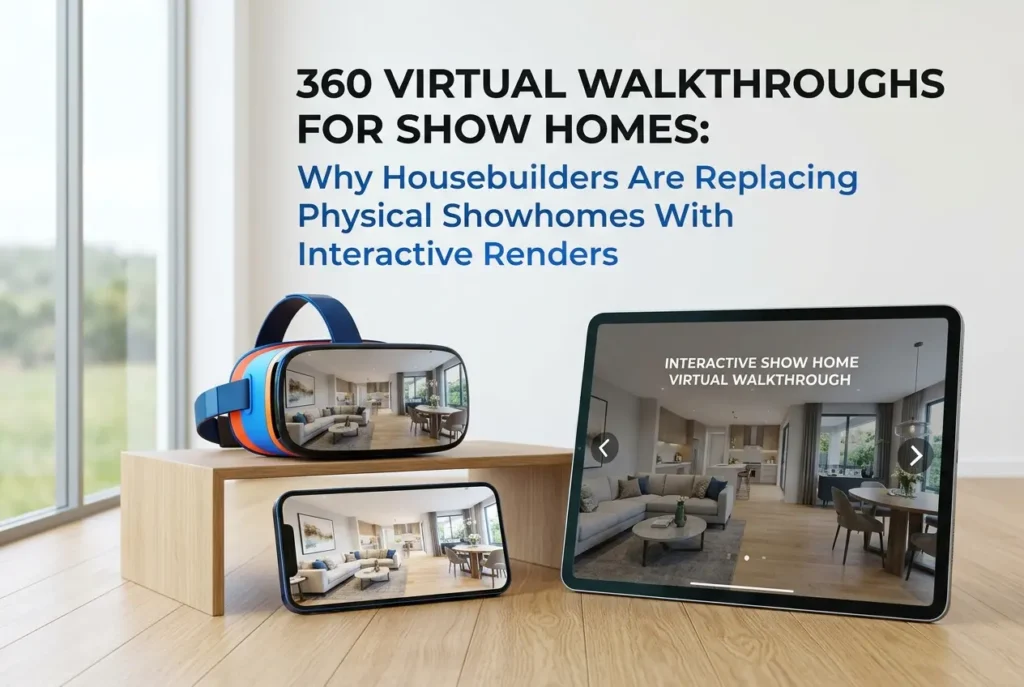
The conversation around 360 Virtual Walkthroughs for Show Homes: Why Housebuilders Are Replacing Physical Showhomes With Interactive Renders has shifted significantly over the past few years. What used to be a niche option — something only the biggest national developers could afford — is now a standard question we get from housebuilders of all sizes. And honestly, when you sit down and think about what a physical showhome actually costs to build, furnish, staff, and maintain, it’s not hard to understand why. Developers are looking at the numbers and asking: is there a smarter way to get buyers emotionally invested in a property before it’s even built? The answer, increasingly, is yes — and it starts with a well-made interactive virtual tour.
We work with residential developers across different markets, and the shift in their briefs over recent years has been clear. Five years ago, a developer might come to us for a few hero interior renders to go alongside their physical showhome. Today, a growing number are asking us to build out an entire interactive experience — one that replaces the showhome entirely, or at minimum runs alongside a scaled-back show unit. The reasons vary. Some sites are remote or awkwardly phased. Some developers are selling off-plan before a single wall is up. Others simply want to reach international buyers who can’t fly in for a viewing. All of them are arriving at the same conclusion: a high-quality 3D 360 virtual tour rendering can do the job of a showhome at a fraction of the ongoing cost.
This post breaks down exactly why that’s true — technically, commercially, and practically. If you’re a developer or sales director weighing up your options, this should give you a clear picture of what’s involved, what the real advantages are, and where the common mistakes happen.
What a Physical Showhome Actually Costs (and Why That Matters)
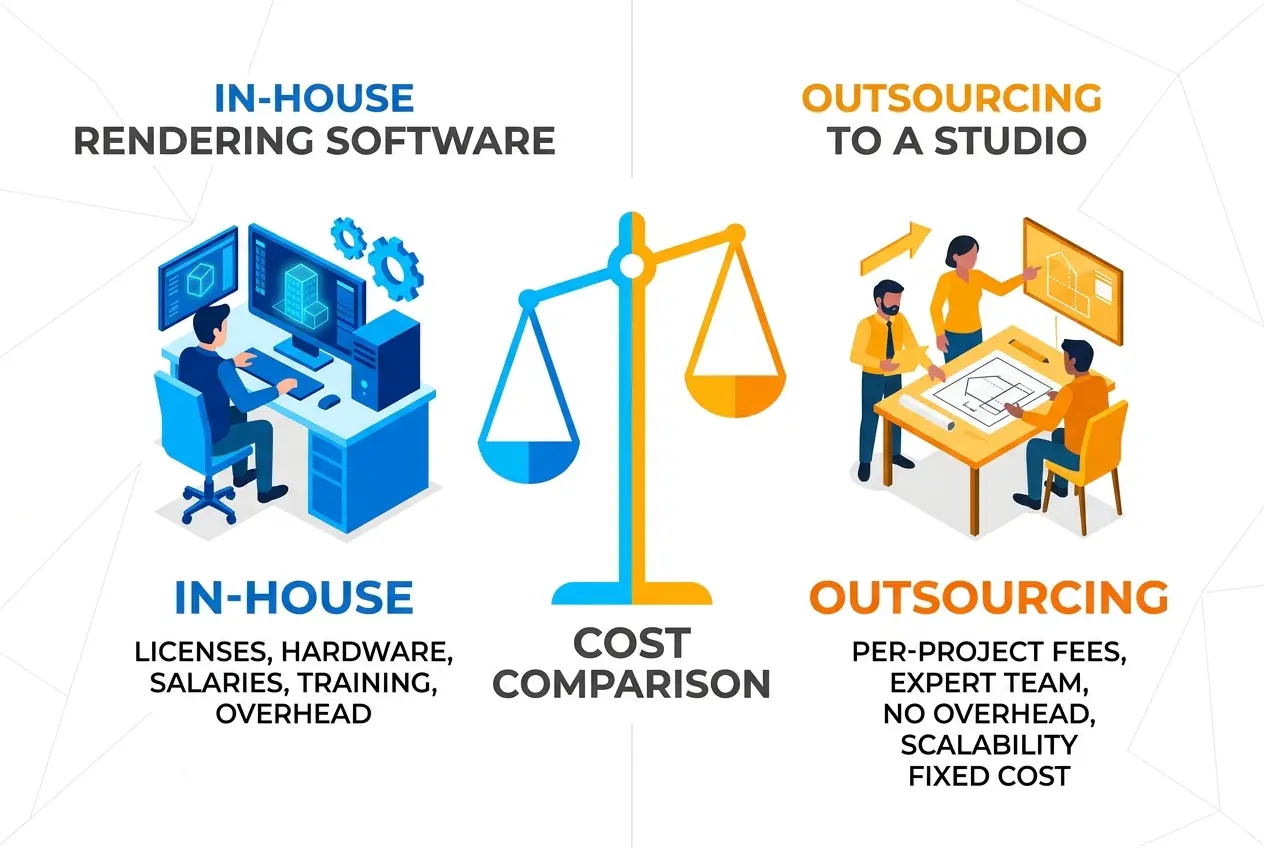
Before we get into the virtuals, it’s worth being direct about what a physical showhome demands. You’re looking at construction costs for a fully fitted unit, a professional interior design fee, bespoke furniture and soft furnishings, ongoing utility costs, staffing, security, and maintenance — for an asset that you’ll eventually need to sell or strip out. For a premium development, this can represent a very significant chunk of your marketing budget, tied up in a single, fixed-location asset that only one person can walk through at a time.
Compare that to a virtual walkthrough. The production cost is a one-time fee. Once it’s rendered and hosted, unlimited buyers can tour the property simultaneously — from their laptop in London, their phone in Dubai, or a tablet at a sales event. There’s no travel required, no appointment needed at 2pm on a Tuesday, and no physical space to heat or clean. The asset keeps working for you across the entire sales campaign and can be updated if the specification changes before you go to site.
If you’ve already been thinking about how residential developers use interior renderings to sell off-plan properties before construction starts, the virtual walkthrough is the next logical step — it takes the static render and puts the buyer inside it.
How 360 Virtual Walkthroughs for Show Homes Actually Work
The term “virtual walkthrough” gets used loosely, so let me be specific about what we’re talking about. A proper interactive 360 tour for a showhome is built from fully rendered 360-degree panoramic scenes — usually one per key room or space — that are stitched together into a navigable experience. The buyer clicks through hotspots to move from the hallway to the living room to the kitchen, rotating their view in every direction as they go. Done well, it feels immersive. Done poorly, it feels like a series of flat images with bad transitions.
The quality of the experience lives almost entirely in the rendering. The lighting has to be right. The materials — timber floors, stone worktops, fabric upholstery — need to hold up when a buyer is staring at them from every angle. The spatial proportions have to be accurate. There’s no hiding behind a flattering camera angle the way you can with a static render. The 360 format is unforgiving, which is why it demands the same level of care in its production as a photorealistic still. If you want to understand the technical depth behind what makes these renders convincing, our post on what makes a commercial exterior rendering look photorealistic lighting materials and context explained covers the principles — and most of them apply directly to interior 360 work too.
The tours are then hosted through a platform — Matterport-style custom builds, or dedicated tour software — and embedded directly into the developer’s website, shared via QR code at sales events, or loaded onto a touchscreen kiosk at a sales suite. The buyer controls the experience. That interactivity is important: buyers who navigate a space themselves build a stronger mental model of it than buyers who watch a passive flythrough video.
The Difference Between a Walkthrough and a Flythrough
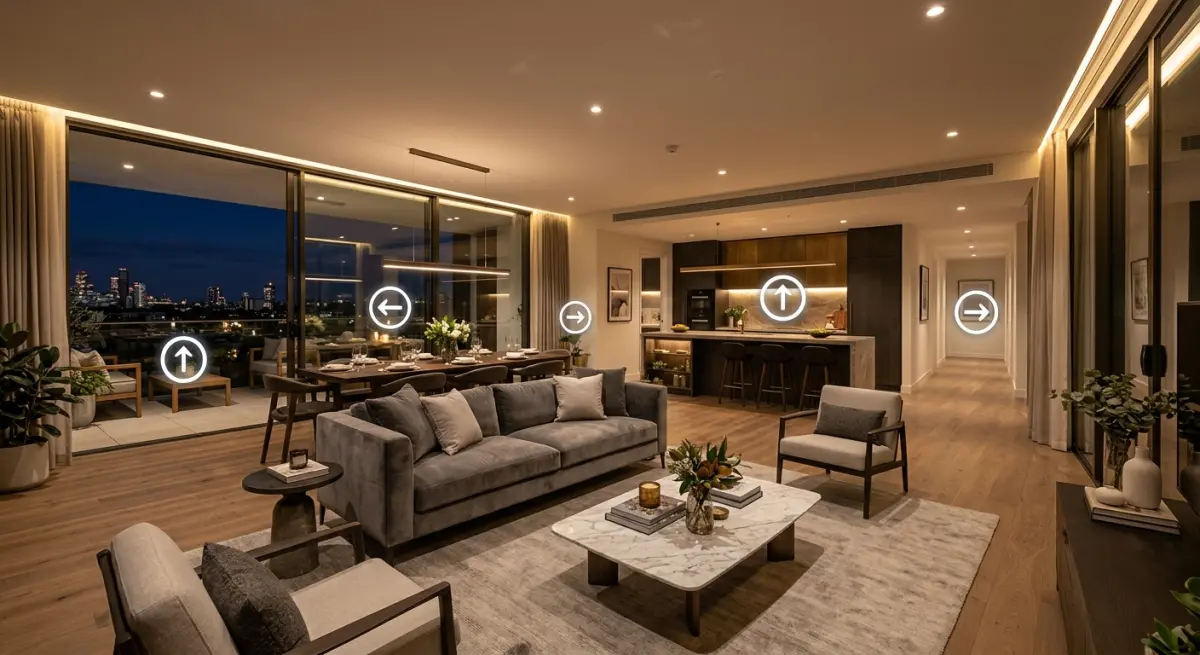
This is a question we field constantly, and it’s worth a clear answer. A flythrough is a pre-rendered animation — the camera moves through the space along a pre-set path, and the viewer watches it like a film. A walkthrough, in the 360 interactive sense, puts the viewer in control. They decide where to look, which room to enter next, how long to spend in the kitchen.
Both have valid uses. For planning presentations or investor decks, a cinematic flythrough can be compelling. But for showhome sales, the interactive walkthrough almost always performs better for a simple reason: buyers want to feel like they’re making a discovery, not being shown a highlight reel. The psychological investment is higher when they’re navigating themselves. We explored this more thoroughly in our piece on 3D walkthrough vs 3D flythrough which presentation format wins more real estate approvals — worth reading if you’re deciding which format to commission.
What Housebuilders Get Right — and What They Get Wrong
We’ve worked on enough of these projects to see clear patterns in what separates a virtual showhome that sells from one that sits unused on the developer’s website.
What works well:
- Starting from detailed, accurate architectural drawings. The closer the model is to the actual build, the more trustworthy the tour feels to buyers — and the fewer corrections you need mid-project.
- Investing in proper interior design direction for the CGI spec. The best virtual showhomes are styled as carefully as a physical one. That means considered furniture choices, realistic material selections, and lighting that matches the target buyer’s lifestyle aspiration.
- Including the exterior context. A buyer wants to understand the approach to the home, the garden, the street scene. An exterior render or aerial 3D rendering embedded at the start of the tour sets the scene properly.
- Pairing the tour with a 3D floor plan rendering so buyers can orient themselves spatially as they navigate. This is a small addition that makes a significant difference to how buyers process the space.
What goes wrong:
- Commissioning the tour too late — when the development is already sold or the sales period is almost over. Virtual showhomes need to go live early, ideally at the pre-launch phase.
- Cutting the rendering budget and expecting the same quality. A 360 tour rendered at low resolution or with generic material libraries looks unconvincing. Buyers notice. They’re comparing your CGI to their experience of real homes, not to other CGI.
- Not briefing the studio properly. Incomplete drawings, unresolved specs, or missing material information slow the project down and lead to revisions that cost more than doing it right the first time. If you’re preparing for a project like this, our guide on how to brief a 3D rendering studio what architects and developers need to prepare before project kickoff is genuinely useful reading.
- Treating the virtual tour as a standalone asset rather than integrating it with the wider sales ecosystem — website, social, sales suite screens, printed QR codes. The tour amplifies everything around it when it’s embedded properly.
Multiple Unit Types, Multiple Tours — How Developers Handle Scale
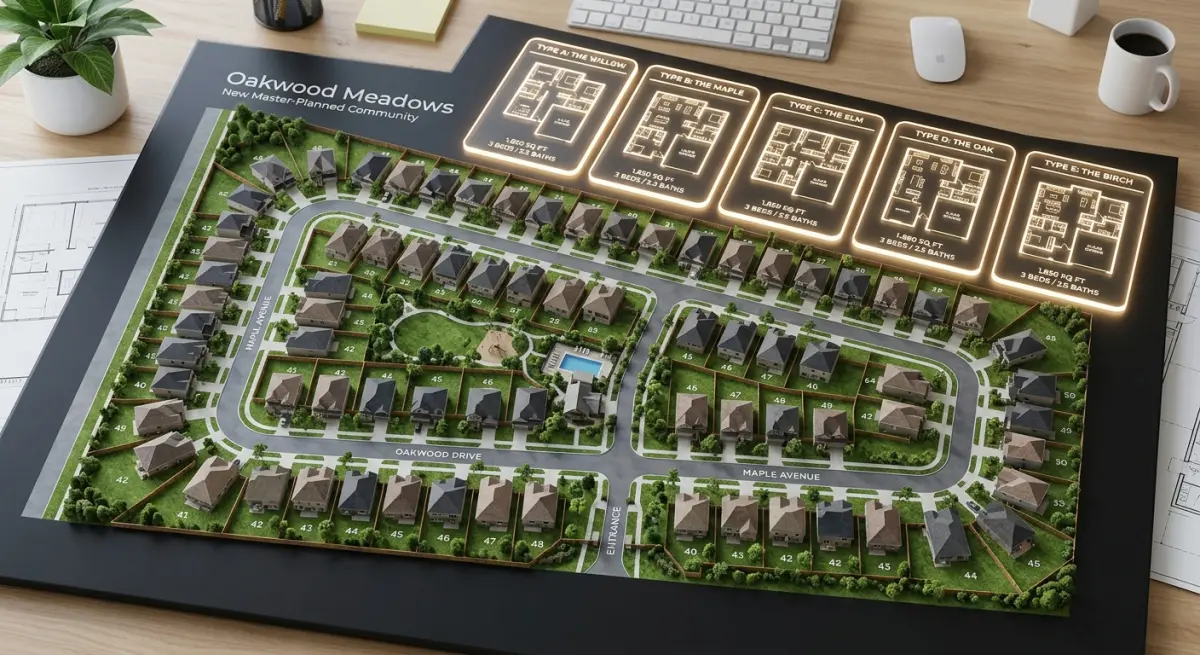
A common question from volume housebuilders: do we need a separate tour for every plot type? Not always. We typically advise developers to tour the most popular unit types — the ones that shift the most plots — and supplement with static renders and 3d floor plans vs 2d cad drawings what homebuyers and investors actually respond to for the remaining types. For a typical scheme with three or four house types, commissioning full interactive tours for the two or three priority plots and high-quality stills for the rest is a sensible balance.
We also build tours with specification variants where budget allows — the same room rendered in two or three different material and finish packages, switchable inside the tour itself. This is particularly effective for off-plan sales where buyers are selecting their own finishes. Instead of pointing to a material sample board, a sales consultant can literally show a buyer what their choice looks like in context, in the actual room proportions of the home they’re buying.
The Commercial Case, Simply Put
A physical showhome is a fixed-cost, fixed-location asset that begins depreciating the day it opens. A virtual showhome is a digital asset that can be hosted anywhere, updated when needed, and used across multiple sales channels simultaneously. It doesn’t get tired. It doesn’t need repainting. It can be translated into different languages for international markets. And if your first phase sells out and you launch phase two with revised unit types, you update the CGI — not the bricks and mortar.
For developers thinking carefully about cost versus output, it’s also worth looking at our breakdown of how much does architectural rendering cost in 2026 a developer8217s pricing breakdown — it puts the investment in real context and helps you understand what you’re actually getting for different budget levels.
The case for virtual showhomes isn’t theoretical. It’s practical, commercial, and increasingly standard. The housebuilders who adopted this approach early are now refining their workflows and getting better results with each development. The ones still weighing it up are paying for physical showhomes that could be doing more, reaching further, and costing less.
If you’re ready to explore what a virtual walkthrough package would look like for your development, contact us at 360archviz.com. We work with residential developers at every scale — from boutique schemes to large multi-phase sites — and we’ll give you a straight answer on what’s achievable for your brief and your timeline.
Frequently Asked Questions
How much does a 360 virtual walkthrough for a show home cost compared to building a physical showhome?
A 360 virtual walkthrough for a show home typically costs between £3,000 and £15,000 depending on the size and complexity of the property, compared to £50,000–£500,000 or more to build and furnish a physical showhome. This significant cost saving makes virtual showhomes an increasingly attractive option for housebuilders, especially on smaller developments where the ROI on a physical build is harder to justify. Ongoing savings on maintenance, staffing, and utility bills add further financial benefit over the lifetime of the sales campaign.
Can buyers get a realistic sense of space and finish quality from a 360 virtual showhome?
Yes, modern 360 virtual walkthroughs use photorealistic CGI rendering technology that accurately replicates materials, lighting, and spatial proportions to give buyers a genuine sense of scale and finish quality. Interactive features allow users to move freely between rooms, zoom into details like tiling or worktop finishes, and even switch between different specification options in real time. Housebuilders report that buyers who engage with high-quality virtual showhomes arrive at sales appointments with greater confidence and fewer objections about the product.
What are the main advantages of virtual showhomes for off-plan property sales?
Virtual showhomes are particularly powerful for off-plan sales because they allow housebuilders to market and sell units before construction begins, removing the traditional dependency on a completed show unit. Buyers can explore a fully rendered version of a property that doesn't yet exist, helping them visualise their future home and commit to a reservation earlier in the sales cycle. This accelerates cash flow for developers and reduces the risk of unsold stock as the build programme progresses.
Are 360 virtual showhomes accessible on mobile devices and tablets?
Yes, well-built 360 virtual walkthroughs are fully optimised for mobile devices, tablets, and desktop browsers without requiring any specialist software or app downloads. Many platforms also support VR headset compatibility, giving buyers an even more immersive experience if they choose to use one. Accessibility across all devices is a key commercial advantage, as it means potential buyers can explore a showhome at any time of day from anywhere in the world, dramatically expanding the reach of a housebuilder's marketing.
How long does it take to produce a 360 virtual walkthrough for a new build show home?
Production timelines for a 360 virtual showhome typically range from four to ten weeks depending on the size of the property, the level of detail required, and whether multiple specification variations are needed. The process begins with architectural drawings or BIM files, which CGI artists use to build and texture a fully interactive 3D environment. Working with an experienced virtual tour specialist and providing complete, accurate technical drawings from the outset is the most effective way to keep production on schedule.