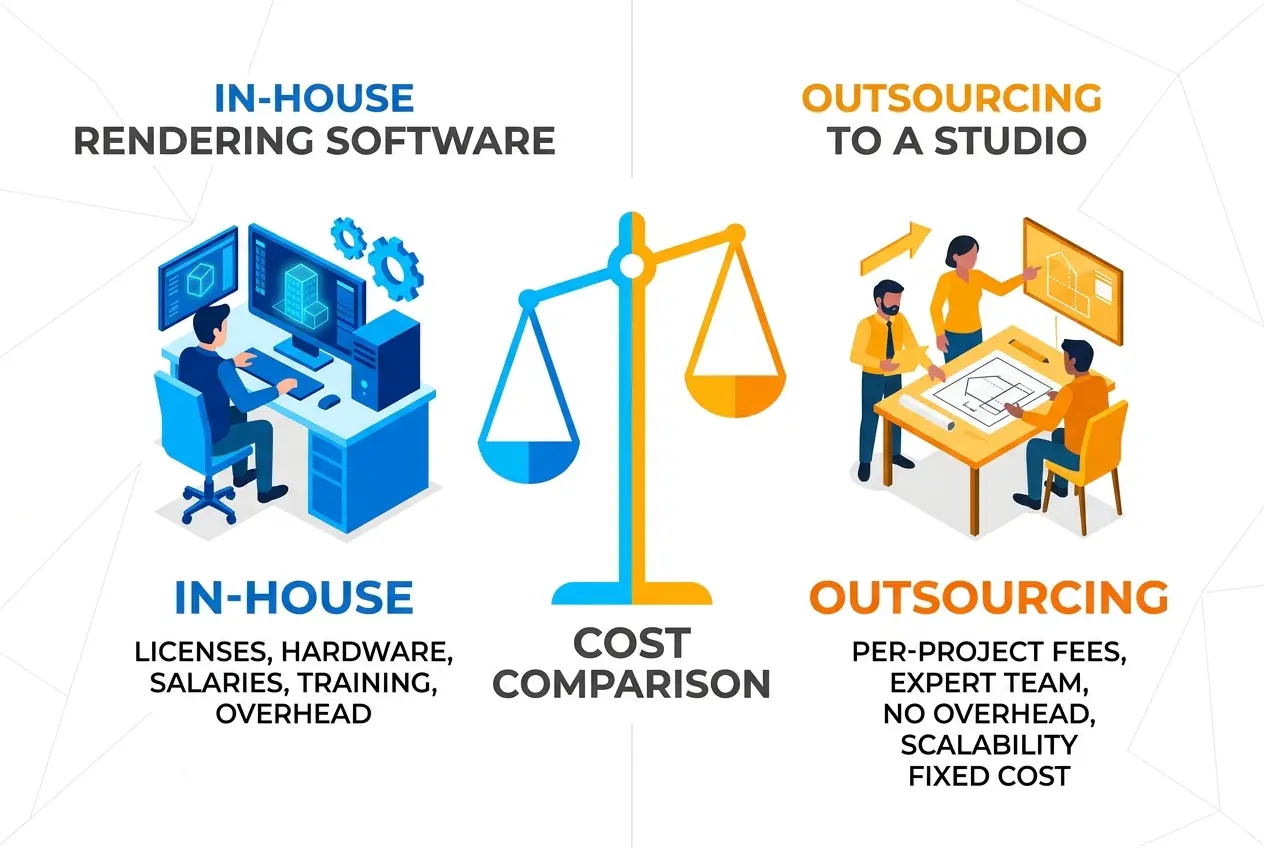

Healthcare development sits in a category of its own when it comes to presentation. Whether you’re working on a new NHS-funded diagnostic hub, a private fertility clinic, or a multi-storey surgical centre, the people you’re presenting to are not just evaluating aesthetics — they’re assessing compliance, patient flow, infection control, wayfinding, and whether the design meets clinical standards they’ve spent careers understanding. 3D rendering for healthcare facilities has become a core communication tool precisely because the gap between a CAD drawing and what a commissioner or investor actually needs to understand is enormous. This post breaks down how that works in practice — what types of visuals are used, what decision-makers are actually looking for, and where most developers and design teams go wrong.
We work with developers across a range of sectors, and healthcare projects consistently have the most demanding approval processes. NHS commissioners in particular are working under procurement frameworks with defined output specifications, and private investors in healthcare need to see that clinical functionality hasn’t been sacrificed for architectural ambition. The design language of a hospital ward is not the same as a hotel lobby, and the renderings need to reflect that. Showing the wrong tone — too residential, too corporate — can actually undermine trust with clinical stakeholders before a single word is spoken in a presentation room.
It’s also worth noting the overlap with other complex building types. We’ve written before about 3D rendering for hospitality interiors how hotels and restaurants use visualisations to secure investor sign-off, and the principles are similar in one key way: both audiences need to feel confident that the space will actually work as intended before a single brick is laid. In healthcare, that burden of proof is just higher.
Why Standard Architectural Visuals Don’t Work for Healthcare Projects
Most architectural rendering follows a fairly predictable script — hero exterior shot, two or three interior views, maybe a site plan. For residential or commercial office schemes, that’s often enough. Healthcare doesn’t work that way. The decision-making group is wider, the technical requirements are more specific, and the visual communication needs to serve multiple audiences simultaneously: clinical leads, estates directors, capital programme managers, infection control teams, and in some cases, public consultation panels.
A generic photorealistic corridor render doesn’t tell a clinical lead anything about handwashing station placement. It doesn’t show an estates director how the clean/dirty utility rooms relate to each other. And it certainly doesn’t help an NHS commissioner validate that the design meets HTM (Health Technical Memoranda) requirements. That’s why healthcare rendering has to be built around functional storytelling, not just visual polish.
In our studio, the brief for a healthcare project always starts with a conversation about who’s in the room when these images get presented. That shapes everything — camera angles, what gets highlighted, how clinical furniture and equipment is modelled, even lighting colour temperature, which needs to feel closer to clinical fluorescent white than warm residential amber.
What NHS Commissioners Need to See
NHS commissioners evaluating capital projects are looking for evidence that the design is safe, compliant, and patient-centred. They are not looking to be impressed by architectural drama. The visuals that work best in these settings tend to combine three things: spatial clarity, clinical accuracy, and legible patient flow.
Spatial clarity means the render communicates room dimensions and relationships honestly. Commissioners have reviewed enough schemes to spot when a render has been shot with an ultra-wide lens to make a room look bigger than it is. We deliberately avoid that approach for healthcare clients. A 24mm equivalent field of view might make a waiting area look cavernous — but if the actual space is tight, that image is going to create problems when the client team walks the site after construction.
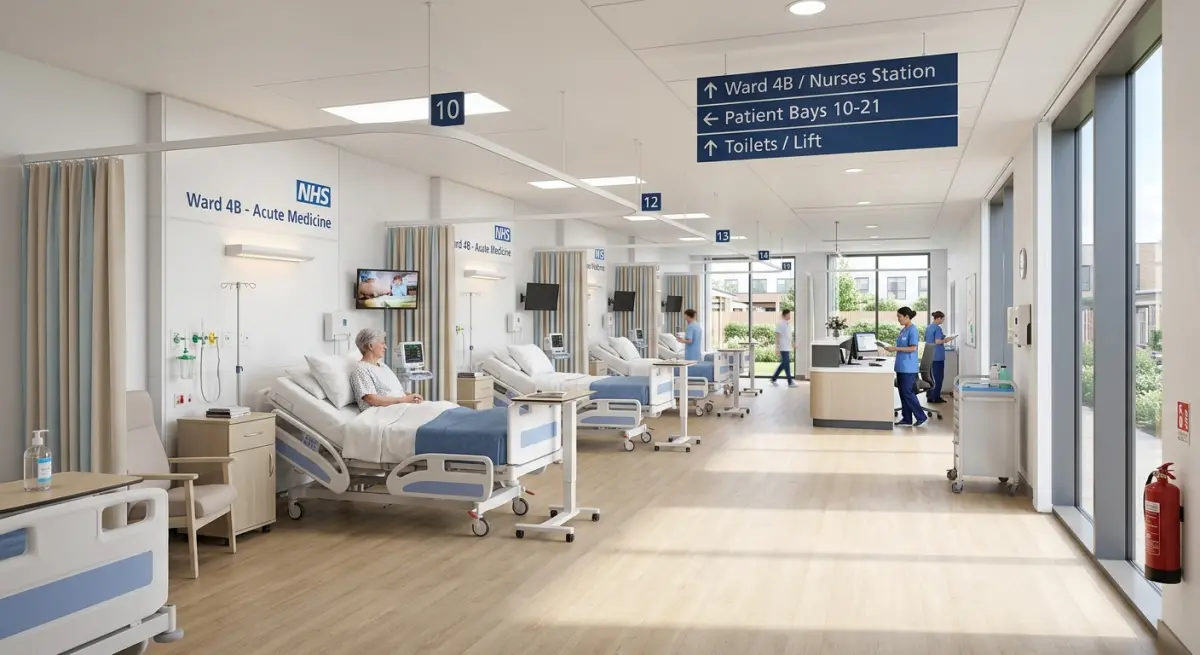
Clinical accuracy means the furniture, equipment, and fittings in the render match what’s actually specified. A bed bay that shows a generic hospital bed without rails, call buttons, or gas panel is going to get questioned by any experienced clinical advisor. We model clinical furniture to spec — not because it makes the image prettier, but because it makes the image credible. The same applies to commercial interior rendering across other building types — accuracy builds trust.
Patient flow is perhaps the most overlooked element. A sequence of renders that takes the viewer from entrance through triage to consultation to discharge tells a story about how the building actually works. We sometimes produce eight to twelve interior views for a healthcare project specifically to walk a commissioner through the patient journey. That’s a different mindset from a typical commercial project where three or four shots might be standard.
Presenting to Private Healthcare Investors: A Different Set of Priorities

Private investors in healthcare — whether they’re backing a diagnostic imaging centre, a private surgical hospital, or a network of GP-plus clinics — have a different primary concern. They care about clinical credibility too, but they’re also assessing market positioning, operational efficiency, and whether the space will attract the consultants and patient base the business plan depends on.
This is where the visual language shifts slightly. Private healthcare facilities often want to signal quality and discretion — a step above an NHS environment without veering into the kind of luxury hotel aesthetic that can feel inappropriate for clinical settings. Think clean biophilic elements, premium joinery in reception areas, natural light as a design feature. The renders need to communicate this positioning clearly, because investors are partly buying into a brand, not just a building.
For these projects, we tend to produce a richer mix of interior types. Reception, consultation rooms, recovery suites, and shared clinical spaces each get their own treatment. We’ve also found that 3D 360 virtual tour rendering works particularly well for private healthcare investors who are reviewing multiple schemes remotely. An interactive walkthrough of a proposed oncology suite or outpatient consultation floor gives investors a much stronger sense of spatial quality than static images alone.
Floor Plans, Wayfinding, and the Technical Visualisation Layer
One aspect of healthcare presentations that often gets underestimated is the supporting visualisation layer — the material that sits alongside the hero renders and handles the technical detail. This is where annotated 3D floor plan rendering becomes genuinely useful rather than decorative.
For healthcare, a well-produced 3D floor plan does several things that a 2D CAD plan cannot. It shows depth relationships between spaces, communicates ceiling heights in a way that’s immediately readable, and allows clinical planners to trace circulation routes without having to mentally reconstruct the space from abstract lines. NHS estates teams frequently use annotated 3D floor plans during soft landings reviews — the process of checking that clinical staff can actually work in the space as designed.
This is similar in principle to what we discussed in our post on 3D floor plans for build-to-rent developments what investors and lettings agents need to see before launch — the audience changes, but the underlying logic is the same. Spatial understanding drives decisions. Give people the visual tools to understand a space, and approvals move faster.
Wayfinding is another area where rendered visuals earn their budget on healthcare projects. Signage design, colour-coded zone differentiation, and visual landmarks within a hospital or clinic are all things that can be shown in renders before they’re ever manufactured or installed. We’ve produced dedicated wayfinding renders for hospital projects specifically to help estates teams and clinical governance groups sign off on the navigation system before construction is complete.
What Actually Works: Observations From Healthcare Briefs
Here’s what we’ve learned from working on healthcare presentations across both public sector and private investment contexts:
| What Works | What Clients Get Wrong |
|---|---|
| Clinically accurate furniture and equipment modelling | Using generic or residential furniture in clinical spaces |
| Neutral, clinical lighting temperatures (5000–6500K feel) | Warm amber lighting that reads as domestic or hospitality |
| Sequential renders that show patient or staff journey | Single hero shots that show no functional context |
| Annotated 3D floor plans for technical review panels | Relying solely on CAD drawings for clinical sign-off |
| Realistic proportions — no ultra-wide distortion | Artificially spacious renders that misrepresent actual rooms |
| Virtual tours for remote investor review | PDF decks only — no interactive or navigable format |
One thing we see consistently: teams that invest properly in the interior render sequence — not just the exterior — have a much smoother path through clinical design review. The exterior image gets attention in a press release. The interiors are what close an NHS commissioner or satisfy a clinical board.
We’ve also found that healthcare projects benefit from briefing a rendering studio early — during RIBA Stage 2 at the latest. Waiting until Stage 4 to commission visuals means the renders become retrospective justification rather than a genuine design communication tool. There’s a good reason to think about this alongside your overall project timeline, and if you’re not sure what to expect from a studio, our guide on how long does architectural 3d rendering actually take a projectbyproject turnaround guide covers the realistic timeframes across different project types.
Exterior Rendering and Site Context for Planning and Procurement
Healthcare facilities often sit within complex site contexts — hospital campuses, urban regeneration zones, or sensitive residential boundaries. The exterior rendering brief for these projects needs to handle that context carefully. Accurate site modelling, proper massing relative to neighbouring buildings, and clear representation of access routes and emergency vehicle circulation all matter.
For larger hospital developments going through planning, aerial perspectives are frequently required to show the massing relationship with surrounding areas. These don’t need to be hyper-photorealistic — a technically accurate aerial 3D rendering that clearly shows the site layout, green space, and pedestrian access is often more useful to a planning committee than a glossy photomontage. For more on how that plays out in planning contexts, our post on exterior 3d rendering for planning permission what councils actually look for in visualisations is worth reading alongside this one.
Bringing It Together for a Winning Presentation
The most effective healthcare facility presentations we’ve worked on combine four elements: a photorealistic exterior in context, a curated sequence of interior renders covering key clinical and patient-facing spaces, annotated 3D floor plans for technical review, and either a virtual tour or a walkthrough animation for the investor or commissioner who couldn’t attend the presentation in person.
That’s not a template — it’s a starting point. Every project has different stakeholders and different approval bottlenecks. The key is understanding what each audience needs to feel confident, and building the visual package around that rather than around what looks impressive in a portfolio.
If you’re developing a healthcare facility and need a rendering team that understands both the clinical context and the investor communication challenge, we’d welcome the conversation. Reach out to us via our contact us page and tell us where you are in the design process — we can advise on the right scope of visuals from the outset.
Frequently Asked Questions
What is 3D rendering and how is it used in healthcare facility development for NHS and private projects?
3D rendering is the process of creating photorealistic digital visualisations of architectural designs before construction begins, allowing healthcare developers to showcase proposed hospitals, clinics, and medical centres in precise detail. In healthcare facility development, these renders are used to present spatial layouts, patient flow pathways, clinical department configurations, and interior environments to NHS commissioners and private investors during the planning and approval stages. This technology helps stakeholders understand the full scope of a project without needing to interpret complex technical drawings or blueprints.
How does 3D rendering help hospital developers secure funding from NHS commissioners?
NHS commissioners require clear evidence that a proposed facility meets clinical standards, infection control requirements, and patient experience benchmarks before approving funding, and 3D renders provide a visually compelling way to demonstrate compliance with NHS technical guidance such as Health Building Notes (HBNs) and Health Technical Memoranda (HTMs). High-quality visualisations allow developers to walk commissioners through department adjacencies, wayfinding strategies, and staff workflow efficiencies in a format that non-technical decision-makers can easily evaluate. This reduces the risk of misinterpretation during procurement processes and strengthens the credibility of planning submissions and outline business cases.
What types of 3D visualisations are most effective for presenting private healthcare clinic designs to investors?
Private healthcare investors typically respond best to a combination of photorealistic exterior renders showing kerb appeal and brand identity, detailed interior visualisations of treatment rooms and patient lounges, and interactive 3D walkthroughs or virtual reality tours that simulate the patient journey through the facility. These formats allow investors to assess the premium quality of finishes, the efficiency of the clinical layout, and the overall commercial attractiveness of the space before committing capital. Flythrough animations are particularly effective for investor presentations and pitch decks, as they convey the full spatial experience in a concise and engaging format.
How much does 3D rendering typically cost for a hospital or healthcare clinic development project in the UK?
The cost of 3D rendering for a healthcare facility in the UK varies significantly depending on the complexity of the project, the number of views required, and the level of photorealistic detail needed, with basic exterior renders starting from around £500 to £1,500 per image and full interior visualisation packages for large hospital schemes potentially ranging from £10,000 to £50,000 or more. Animated walkthroughs and interactive virtual reality experiences command higher fees due to the additional production time involved, but these are often considered a worthwhile investment when pitching for large NHS contracts or securing multi-million-pound private investment. Many specialist architectural visualisation studios offer staged packages tailored to healthcare clients, covering concept renders through to final planning submission quality imagery.
Can 3D rendering be used to demonstrate infection control and clinical compliance in healthcare facility designs?
Yes, 3D rendering can be used to visually communicate infection control strategies by accurately depicting zoning layouts, segregated clean and dirty corridors, isolation room configurations, handwashing station placements, and ventilation system designs within photorealistic environments. This is particularly valuable when presenting designs to NHS Estates teams or clinical leads who need to verify that the facility meets HTM 03-01 ventilation standards, HTM 04-01 water safety requirements, and other compliance frameworks. By integrating these technical elements into detailed visualisations, developers can proactively address clinical concerns during the design review stage, reducing costly revisions later in the procurement process.