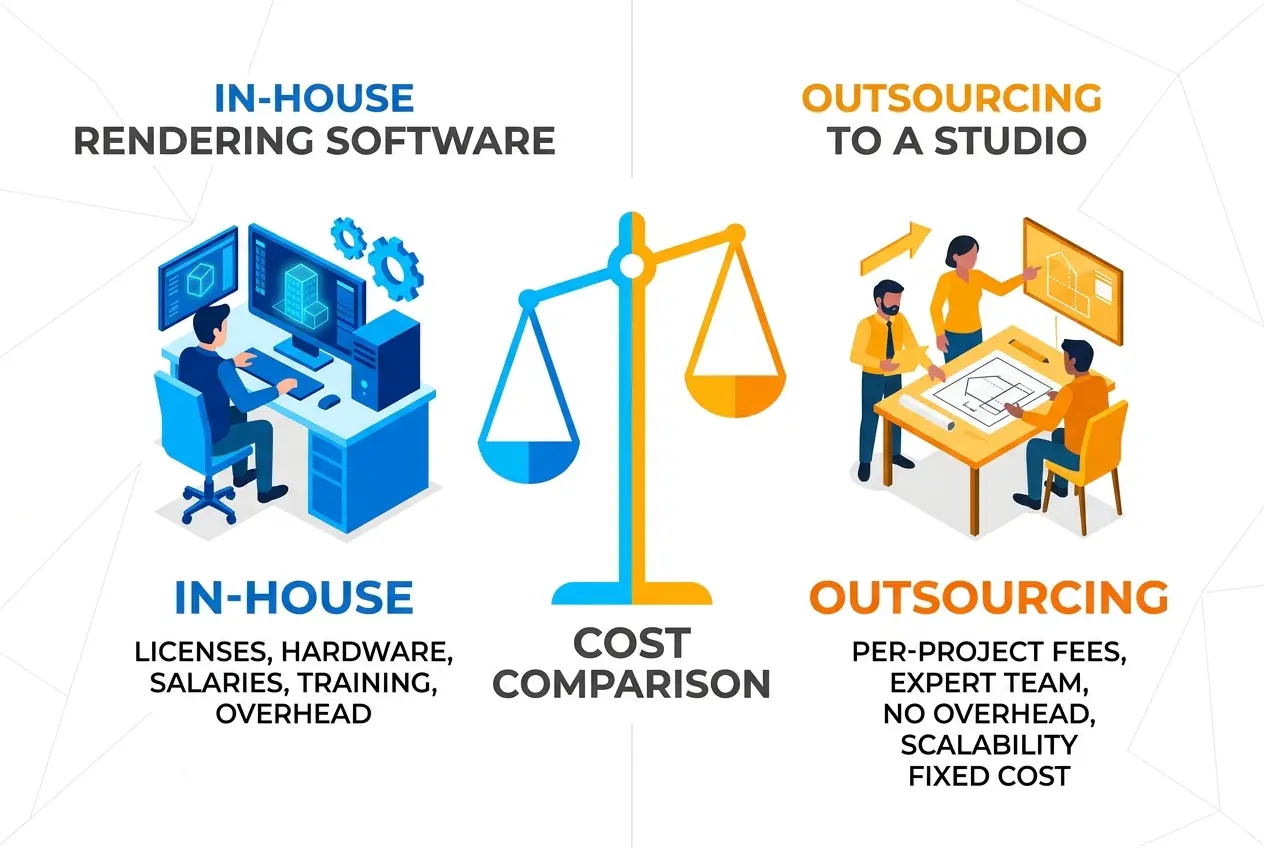

Every developer comparing quotes eventually hits the same fork in the road: a local studio quoting several times more than an offshore team promising similar results. The gap looks straightforward on paper. It rarely is in practice. The conversation around Onshore vs Offshore Architectural Rendering Studios: What Developers Are Actually Giving Up on Price is one I’ve had hundreds of times — from housebuilders in the UK to commercial developers in Australia, all trying to figure out whether the price difference reflects real value or just geography. The honest answer is: sometimes yes, sometimes no, and knowing which situation you’re in before you commit is what this post is about.
I run the technical side of a rendering studio based in India. We serve clients across the UK, US, Australia, and the Middle East. That puts us squarely in the “offshore” category — but we work against the same quality benchmarks as any London or Sydney studio. So I’m not writing this to defend offshore work blindly or to dismiss onshore studios. I’m writing it because most of the framing around this debate is wrong, and developers end up making expensive mistakes because of it.
Let’s get into what actually separates studios — and where price genuinely does tell you something useful.
The Price Gap Is Real — But It’s Not What It Looks Like
Onshore studios in the UK, USA, or Australia carry real overhead. Office rent, software licences, senior staff salaries, and local market rates all push prices up. An offshore studio in India, Eastern Europe, or Southeast Asia operates with structurally lower costs. That difference is legitimate and it shows up in every quote.
But here’s what developers get wrong: they assume the price gap maps directly onto a quality gap. It doesn’t — not automatically. There are offshore studios producing work that matches or exceeds what onshore competitors deliver. There are also offshore studios producing rushed, template-heavy renders that look professional in portfolio screenshots but fall apart the moment you ask for revisions, technical accuracy, or site-specific context.
The same is true onshore. A high price doesn’t guarantee a great process. Some onshore studios are expensive because of location, not because of talent. And some genuinely do earn their rates through senior oversight, tight QA processes, and deep knowledge of local planning and marketing requirements.
Price is a proxy — a noisy one. The real question is what systems, skills, and communication processes sit behind the number.
Onshore vs Offshore Architectural Rendering Studios: Where the Real Tradeoffs Live
Communication and Time Zones
This is the most practical difference day to day. An onshore studio in your time zone means same-day feedback loops. You call at 10am, get a response within the hour, and can have a revised frame by end of day. That speed matters on fast-moving projects — particularly when you’re hitting a planning deadline or a marketing launch.
Offshore studios with poor communication structures make this worse than it needs to be. If your feedback gets picked up 16 hours later, one revision cycle takes nearly two days. On a project with four or five revision rounds, that compounds badly.
The fix isn’t unavoidable — it’s a management question. We run overlap hours with UK and Australian clients specifically to close this gap. But you need to ask any offshore studio directly: what are your working hours relative to mine, who is my point of contact, and how fast do you turn around feedback responses? Studios that can’t answer that clearly are telling you something about how they operate.
Local Market Knowledge
This one is underestimated. Rendering isn’t just technical — it’s contextual. A residential exterior for a UK housebuilder should reflect British streetscapes: brick textures, grey skies, appropriate landscaping, planning-compliant context. A developer selling off-plan apartments in Dubai wants different light, different material finishes, different surrounding context entirely.
Onshore studios often carry this knowledge naturally. They’ve driven past similar developments. They know what buyers in that market respond to. Understanding how residential developers use interior renderings to sell offplan properties before construction starts requires cultural fluency as much as technical skill — knowing which lifestyle cues resonate with specific buyer demographics.
Offshore studios can absolutely develop this knowledge, but it requires active effort. The best offshore teams maintain asset libraries specific to different markets and brief their artists on regional context before a project starts. The worst ones apply the same sunny-sky, generic-furniture template to every project regardless of location.
Technical Depth and Senior Oversight
High-end onshore studios typically have senior artists with ten or more years of experience reviewing work before it leaves the building. That oversight layer catches issues — a material that reads wrong, a shadow that doesn’t match the sun position, a perspective that subtly misrepresents the scale of a room.
In volume-driven offshore operations, this layer gets thin. Junior artists working to aggressive turnaround times don’t always have the experience to catch their own errors. Understanding what makes a commercial exterior rendering look photorealistic lighting materials and context explained — from atmospheric haze to material micro-texture — is the kind of knowledge that only comes with years on specific project types.
This is why portfolio review matters more than price comparison. Ask studios to show you work on projects similar in type, scale, and market to yours. Don’t just look at the hero images — ask what the revision process looked like, how many rounds it took, and whether the final output matched the brief.
What Developers Actually Lose When They Go Purely on Price

Let me be direct about the specific things that get compromised when a studio is winning work primarily on low cost rather than on quality.
| What Gets Cut | Onshore Impact | Offshore (Budget) Impact |
|---|---|---|
| Senior artist review time | Usually built into process | Often absent or rushed |
| Revision allowance | Typically generous | Often capped very tightly |
| Material library quality | Proprietary, curated | Generic or shared assets |
| Local context accuracy | Strong | Variable |
| Brief comprehension | Deep, proactive | Literal, minimal initiative |
| Turnaround consistency | Predictable | Can slip under volume pressure |
The issue isn’t offshoring. It’s underfunding the production process. A developer who squeezes a studio’s margins hard enough will always get work that reflects those constraints — regardless of where the studio is based.
Where Offshore Studios Genuinely Win
There are real scenarios where an offshore studio is the right choice — and not just because of budget.
Volume work benefits enormously from offshore capacity. If you’re running a large residential development and need 3D floor plan rendering for fifty or sixty unit types, or multiple exterior angles across a phased masterplan, the bandwidth of a well-run offshore studio becomes a practical advantage. Onshore studios often have limited headcount and can’t absorb that volume without extending timelines.
Round-the-clock production is another genuine advantage. When a brief goes in at 5pm UK time, a studio in India picks it up at the start of their morning and delivers work ready for the client’s next day. That’s not a compromise — it’s a feature, when the studio is good enough to work with minimal hand-holding. Knowing how to brief a 3D rendering studio what architects and developers need to prepare before project kickoff becomes especially important in this model — a clear, complete brief removes the need for back-and-forth and lets async production flow smoothly.
Technology parity is also largely a non-issue now. The same software — 3ds Max, V-Ray, Unreal Engine, Corona — runs identically in India or the UK. Access to good tools is global. The difference is who is using them and how well.
The Hybrid Reality Most Developers Don’t Consider

Many experienced developers have moved to a hybrid approach: a local consultant or architectural visualisation coordinator who handles briefing, feedback, and quality control, working with an offshore production studio. The local person knows the market and the client; the offshore team handles production volume. This splits the value proposition sensibly.
We’ve seen this work particularly well for developers running complex mixed-use schemes that require a broad set of deliverables — aerial 3D rendering, interior views, site context shots, and interactive content like 3D 360 virtual tour rendering all produced in parallel. The coordination overhead is real, but the output quality and speed at scale is hard to match with a single onshore studio of comparable cost.
What to Actually Evaluate Before You Sign
Stop comparing line-item prices. Start comparing these instead:
- Revision policy: How many rounds are included, and what constitutes a “round”? Vague policies lead to scope disputes.
- Who actually works on your project: Are senior artists involved, or is it all junior production staff? Ask directly.
- Communication structure: Is there a dedicated project manager or a shared inbox? How fast do they respond to a test query?
- Portfolio specificity: Can they show you work on the same type of project — same asset class, same market, similar scale?
- Briefing process: Do they ask smart questions when you first approach them, or do they just send a quote?
These questions surface what’s actually behind a price — and they apply equally to onshore and offshore studios. A studio that gives you confident, specific answers to all of them is worth paying more for, wherever they’re based.
Conclusion: Price Is the Wrong Question
The Onshore vs Offshore Architectural Rendering Studios debate tends to collapse into a price conversation when it should be a capability conversation. The developers who get consistently strong results — whether from a studio in London or one in Hyderabad — are the ones who evaluate process, not just portfolio screenshots and day rates.
Offshore can absolutely deliver onshore-quality results. But not every offshore studio does. And not every onshore studio justifies its premium. The market isn’t cleanly split by geography — it’s split by how seriously a studio takes quality control, communication, and understanding what a developer actually needs from a piece of visualisation work.
If you’re not sure how to evaluate your options or want to understand what a serious offshore studio actually looks like in practice, contact us at 360archviz. We’re happy to walk through your project requirements, show you relevant work, and be straight with you about whether we’re the right fit — because that conversation is more useful to you than a low quote that doesn’t hold up under scrutiny.
Frequently Asked Questions
What do developers actually lose in quality when choosing offshore architectural rendering studios over onshore ones?
Developers who choose offshore rendering studios often sacrifice nuanced understanding of local building codes, materials, and design aesthetics that onshore studios inherently possess. Communication delays across time zones can also lead to misinterpretations of briefs, resulting in costly revision cycles that erode the initial cost savings. Additionally, offshore studios may lack familiarity with the target market's buyer expectations, producing renders that feel generic rather than compelling to local purchasers.
How much cheaper are offshore architectural rendering studios compared to onshore studios on average?
Offshore architectural rendering studios, particularly those based in India, Eastern Europe, or Southeast Asia, typically charge 40% to 70% less than their onshore counterparts in the US, UK, or Australia. A high-quality exterior render that costs $800 to $1,500 from a US-based studio might run $200 to $500 from an offshore provider. However, when factoring in revision rounds, extended timelines, and potential rework, the real cost gap often narrows significantly.
Are there project types where offshore rendering studios perform just as well as onshore studios?
Offshore rendering studios can deliver excellent results for straightforward residential projects, repetitive floor plan visualizations, and large-volume rendering work where templates and established briefs minimize ambiguity. For cookie-cutter developments or projects where speed and volume outweigh hyper-local market nuance, offshore studios represent a genuinely strong value proposition. However, luxury developments, mixed-use flagship projects, and renders intended for high-stakes marketing campaigns tend to benefit significantly from onshore expertise and tighter creative collaboration.
What hidden costs should developers watch for when hiring an offshore architectural rendering studio?
Developers frequently underestimate the cost of extended revision cycles caused by miscommunication, which can add two to four additional rounds of changes that consume both time and budget. Intellectual property concerns, data security risks, and contract enforceability across jurisdictions are also underappreciated financial and legal exposures. Time zone friction can delay project delivery by days or weeks, which in fast-moving property markets can directly impact sales launch timelines and marketing spend efficiency.
How do turnaround times compare between onshore and offshore architectural rendering studios?
Onshore studios typically deliver initial drafts within three to five business days with same-day or next-day feedback loops due to shared working hours, enabling faster iterative collaboration. Offshore studios may offer similar or faster raw turnaround claims, but asynchronous communication means a single round of feedback can consume an additional 24 to 48 hours per cycle. For developers working against tight pre-sales or planning submission deadlines, this compounding delay is often the deciding factor that makes onshore pricing worth the premium.