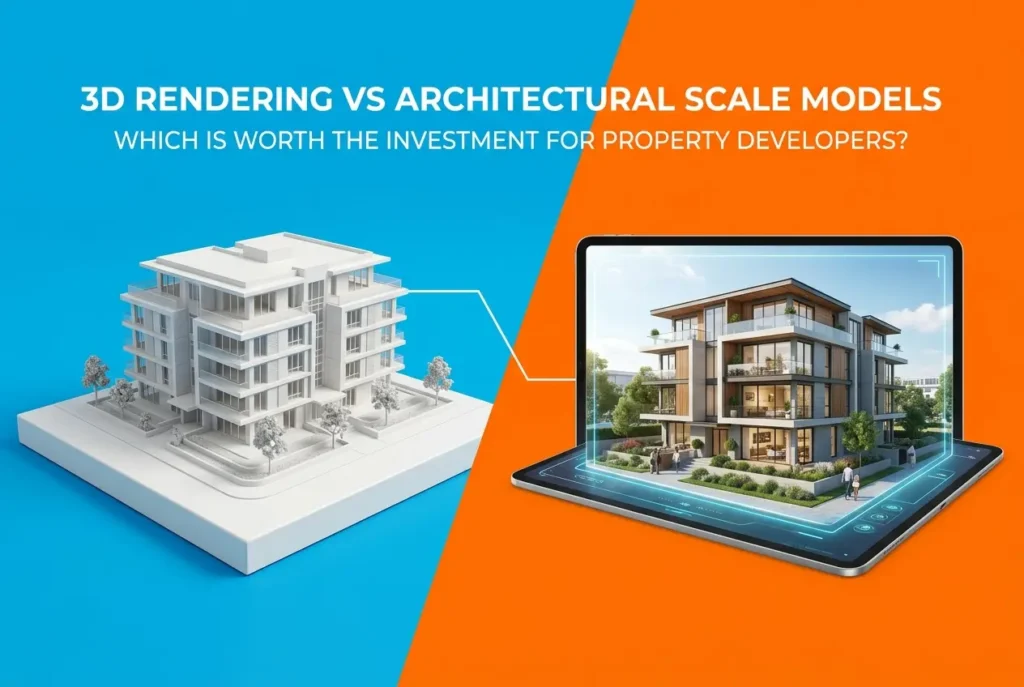
Property developers face this question constantly: when it comes to presenting a project — whether to investors, buyers, or planning committees — should you commission a physical architectural scale model or invest in 3D Rendering vs Architectural Scale Models: Which is Worth the Investment for Property Developers? It’s not a trivial decision. Both options cost real money, take real time, and serve specific communication purposes. But in our experience working with developers across residential, commercial, and mixed-use sectors, the two are rarely equal in what they deliver. This post breaks down exactly how they compare, where each shines, and where one consistently outperforms the other in real-world development scenarios.
Let’s be direct from the start: physical scale models are a legacy tool. They have genuine strengths — tactile presence, boardroom gravitas, the ability to let someone physically point to a location. But they’re also expensive to produce, fragile to transport, difficult to update, and completely static. 3D rendering, by contrast, is digital, repeatable, distributable, and — when done well — photorealistic enough to make buyers emotionally connect with a building that hasn’t been built yet. That emotional connection drives sales. That’s the fundamental tension at the heart of this comparison.
In our studio at 360archviz.com, we’ve worked on projects ranging from single-family homes to large mixed-use urban developments. We’ve had clients who came to us after spending significant budgets on physical models, only to realize they couldn’t use those models in digital marketing, couldn’t send them to overseas investors, and had to start over visually. Understanding the real trade-offs before you commit your budget can save you a lot of grief.
What Architectural Scale Models Actually Cost You (Beyond the Price Tag)
Scale models look impressive on a conference table. A well-crafted physical model of a residential tower or a masterplan development communicates scale in a way that’s immediately intuitive — especially to non-technical stakeholders who don’t read drawings. That’s the strongest argument for them.
But the costs compound quickly. First, there’s the production cost — which for a detailed architectural model of a mid-size development can run into thousands of dollars, depending on complexity and the materials used. Then there’s lead time: a quality model takes weeks to produce. If your design changes — and in development, it almost always does — you either live with an outdated model or spend again to update it. Models can’t be revised with a software tweak. A physical change means physical labour.
Transport is another underrated issue. Models are fragile. Shipping a detailed foam-and-acrylic model between cities, let alone internationally, requires custom crating and adds cost and risk. One client told us they’d had a beautifully crafted model damaged in transit before a key investor meeting. That’s not a recoverable situation in the moment.
And then there’s the question of where the model ends up after its primary use. Physical models typically end up on a shelf. They can’t be uploaded to a website. They can’t be emailed to a buyer in another country. They don’t work as Instagram content. In today’s marketing environment, that’s a significant limitation.
3D Rendering vs Architectural Scale Models: Which is Worth the Investment for Property Developers Who Need Flexibility?
This is where 3D rendering consistently wins. The digital nature of rendered images and animations means that once the 3D model is built, the asset library is reusable. A single detailed 3D model of your development can produce exterior stills, interior walkthroughs, aerial perspectives, floor plan renderings, and virtual tours — all from the same source file.
Consider what that means practically. You start with residential exterior rendering for your planning submission. The same model gets used to produce 3D floor plan rendering for your brochures. You add a 3D 360 virtual tour rendering for your website. If the project is a mixed-use development with commercial space, you pull interior renders for the commercial units too. That’s a complete marketing and presentation suite — all from one set of assets.
A physical model can do none of that. It does one thing: sit on a table and be looked at from the outside.
The other major advantage is iteration. In development, design decisions change frequently — especially during the pre-approval phase. With 3D rendering, changing a facade material, adjusting landscaping, or swapping a roof profile is a matter of revising the digital scene. With a physical model, it means rebuilding. For developers working under time pressure, that flexibility is genuinely significant.
Where Physical Models Still Have a Role
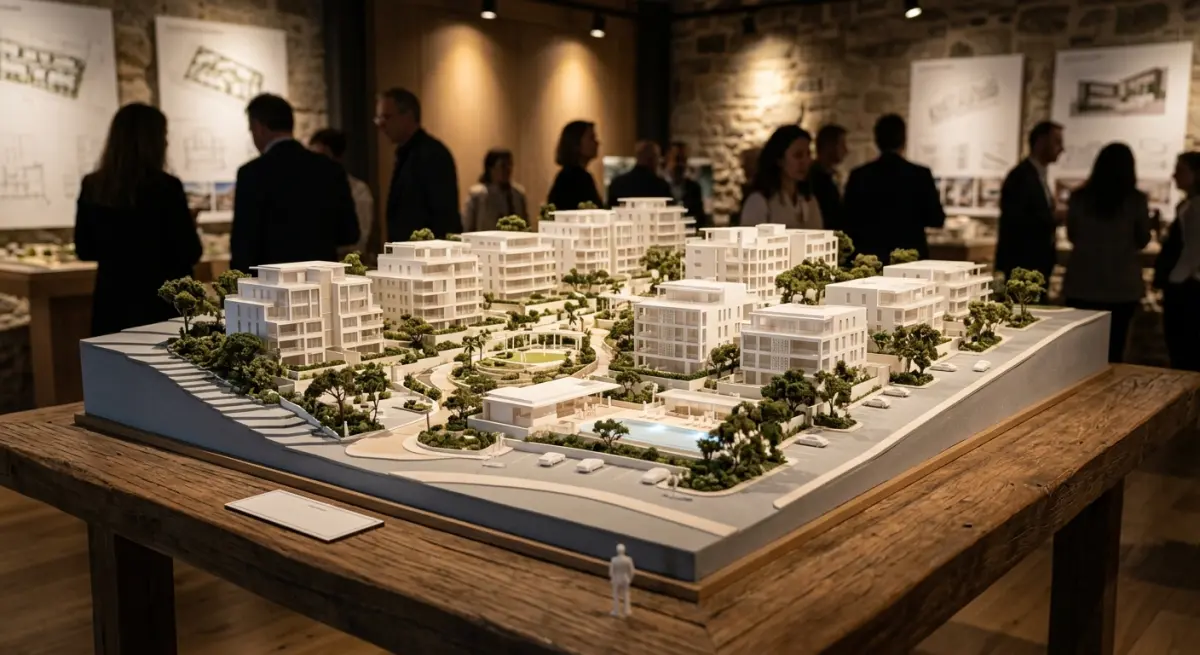
It would be intellectually dishonest to dismiss physical models entirely. There are specific scenarios where they remain the right tool.
Large-scale masterplan presentations — particularly in formal government or municipal settings — sometimes benefit from the presence of a physical model. When multiple stakeholders are gathered in a room and need to discuss the spatial relationships between buildings, topography, and public space, a physical model allows a kind of collaborative, gestural discussion that a projected image doesn’t always replicate.
Heritage or conservation projects sometimes favour physical models because planning committees dealing with sensitive sites want to assess massing and scale in a tangible way. That said, even in these contexts, exterior 3D rendering for planning permission what councils actually look for in visualisations has become the norm. Most planning authorities now expect photomontages and contextual renders, not just physical massing models.
The honest conclusion is that physical models serve a narrow and shrinking set of use cases. For most property developers — particularly those working on residential, commercial, or mixed-use projects where sales and marketing are central — they are not the primary tool they once were.
What Clients Get Wrong About Both Options
The most common mistake we see is treating visual presentation as a single-purpose expense rather than a multi-use asset. Developers sometimes commission a physical model for a launch event and then wonder why they have nothing for their digital marketing campaign. Or they commission a single exterior render and then realize too late they need interior visuals for their sales suite, a flythrough for a YouTube pre-launch, and a virtual tour for their project website.
The smarter approach is to plan your visual assets holistically before you brief anyone. If you’re not sure how to do that, reading about how to brief a 3D rendering studio what architects and developers need to prepare before project kickoff is a good starting point. The brief shapes everything — what assets you’ll need, in what format, at what stage of the project lifecycle.
Another common misunderstanding is around cost. Developers sometimes assume that 3D rendering is more expensive than a physical model because of the perceived complexity of the technology. In reality, for a comparable level of detail and communication effectiveness, professional 3D rendering is frequently more cost-efficient — and the assets have a far longer shelf life. For a full breakdown of what to expect to pay, our guide on how much does architectural rendering cost in 2026 a developer’s pricing breakdown covers the variables in detail.
We’ve also seen developers invest heavily in renderings but choose the wrong format for their presentation context. A still image is fine for print, but if you’re presenting to investors in a boardroom, a 3D walkthrough vs 3D flythrough which presentation format wins more real estate approvals is worth considering — the right format matters as much as the quality of the render itself.
A Practical Comparison: Side by Side
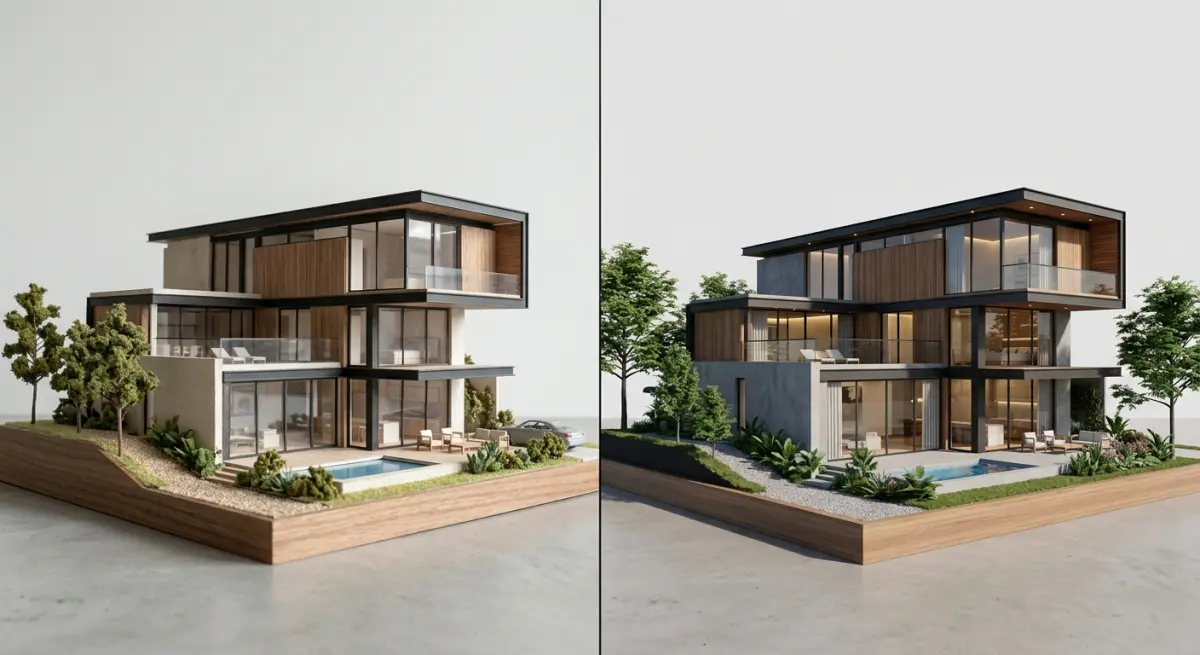
| Factor | Physical Scale Model | 3D Rendering |
|---|---|---|
| Revision flexibility | Low — physical rework required | High — digital edits are efficient |
| Marketing usability | Very limited — not digital | Extensive — web, print, social, video |
| Interior presentation | Not possible | Full interior renders available |
| Remote sharing | Not practical | Instant — email, web, cloud |
| Boardroom presence | Strong tactile impact | Strong with large-format display or animation |
| Planning submission use | Occasionally accepted | Standard expectation in most jurisdictions |
| Asset longevity | Physical lifespan only | Files stored, reusable across project lifecycle |
The Investment Decision in Plain Terms
When developers ask us whether to invest in 3D rendering vs architectural scale models, our answer is almost always the same: ask yourself how many different jobs you need your visual assets to do. If the answer is more than one — planning, marketing, investor relations, sales suite, website — then 3D rendering isn’t just worth the investment, it’s the only format that can do all of those things.
Physical models have their place, and we’re not suggesting they’ll disappear entirely. But for most property developers operating in today’s environment — where buyers research online, investors are often international, and planning authorities expect digital contextual visualisations — a physical model is increasingly a supplementary item rather than a core deliverable.
The return on well-executed 3D rendering is visible and direct: faster pre-sales, stronger planning applications, compelling digital marketing, and assets that remain useful throughout the entire project lifecycle. A physical model, however beautifully made, can’t match that range. If you’re ready to think through your visual asset strategy for an upcoming development, contact us at 360archviz.com — we’ll help you figure out exactly what you need and in what format, without overcomplicating it.
Frequently Asked Questions
How much does 3D architectural rendering cost compared to a physical scale model?
3D architectural rendering typically costs between $500 and $5,000 per image depending on complexity, while a detailed physical scale model can range from $3,000 to $50,000 or more based on size and materials. For property developers working on multiple projects or requiring frequent revisions, 3D rendering offers significantly lower long-term costs since changes can be made digitally without rebuilding from scratch. Physical scale models carry higher upfront and revision costs but may justify the investment for landmark projects where tactile client engagement is critical.
Which is better for selling off-plan properties to buyers: 3D rendering or a scale model?
3D renderings are generally more effective for off-plan property sales because they can be distributed digitally across websites, social media, and marketing brochures, reaching a far wider audience than a single physical model displayed in a sales office. High-quality photorealistic renders allow potential buyers to visualize interiors, lighting, and landscaping in detail, which drives emotional purchasing decisions. However, scale models placed in premium sales suites can create a powerful tactile experience that builds trust and credibility, particularly for luxury residential or large mixed-use developments.
How long does it take to produce a 3D architectural rendering versus a physical scale model?
A professional 3D architectural rendering typically takes between 3 and 10 business days to complete, depending on the level of detail and number of revisions required. A high-quality physical scale model, by contrast, usually requires 4 to 12 weeks from design approval to delivery, making it a less agile option when project timelines are tight. For developers facing fast-moving market conditions or planning deadlines, 3D rendering offers a clear turnaround advantage.
Can 3D rendering replace physical scale models for planning permission and council presentations?
In most jurisdictions, 3D renderings are now fully accepted and widely used in planning applications and council presentations, offering detailed visual context that planning authorities find easy to assess. Many local councils and design review panels actually prefer digital submissions because they can include multiple viewpoints, streetscape integration, and environmental impact visuals that a single scale model cannot easily convey. Physical scale models may still carry additional persuasive weight in high-profile or contested planning hearings where a tangible display can engage committee members more effectively.
What are the long-term ROI differences between investing in 3D rendering versus architectural scale models for property developers?
3D renderings deliver stronger long-term ROI for most property developers because the digital assets can be repurposed across marketing campaigns, investor decks, social media, and virtual tours without additional production costs. A physical scale model depreciates immediately after a project launches and cannot be easily adapted if designs change, whereas 3D files can be updated and re-rendered at a fraction of the original cost. Developers managing multiple projects or building a portfolio brand will typically find 3D rendering the more scalable and cost-efficient investment over time.