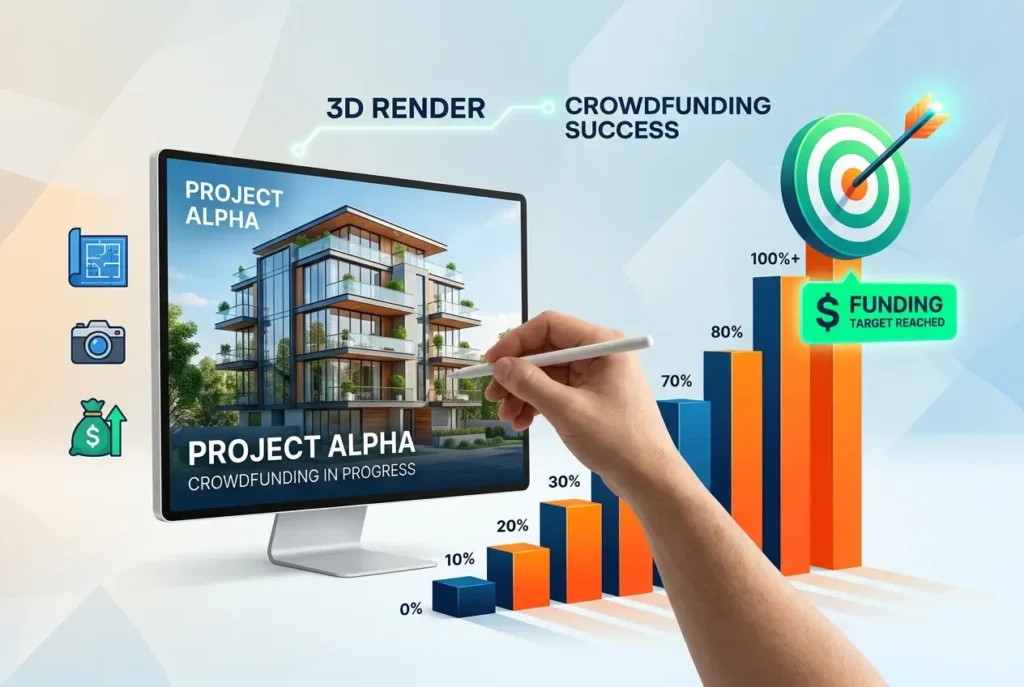
Property crowdfunding has matured considerably over the past few years. Platforms like Crowdproperty, Shojin, and various Regulation Crowdfunding portals in the US and UK now host development opportunities that compete directly against each other for investor attention. In that environment, how a project looks at the point of listing matters enormously. Developers who use 3D renders in crowdfunding campaigns consistently report stronger early traction — not because visuals are decorative, but because they do the communicative work that floor plans and financial spreadsheets simply cannot. When a potential investor is deciding between two similar yield projections, the project they can actually picture tends to win.
This post breaks down how and why professional 3D visualisation fits into property crowdfunding, what types of renders actually move the needle for investors, and the common mistakes developers make when they try to cut corners on visuals for what is, in reality, a high-stakes fundraising document.
Why Crowdfunding Investors Respond Differently Than Traditional Buyers
A traditional off-plan buyer is typically guided through a sales process — by an agent, a show home, a brochure, perhaps a site visit. They have human touchpoints that build confidence over time. A crowdfunding investor makes their decision largely in isolation, often on a mobile screen, scrolling through a campaign page at 10pm. There’s no sales consultant walking them through it. The visuals have to carry that weight themselves.
Retail investors on crowdfunding platforms are also emotionally different from institutional buyers. Institutions analyse loan-to-value ratios, exit strategies, and developer track records. Retail investors do that too — but they also want to feel something about the project. They want to believe in it. A photorealistic exterior render showing the finished building in a recognisable street context does that in seconds. A planning drawing or a rough CGI sketch does not.
This is why understanding why context matters in architectural rendering — how street-level surroundings and people make or break a development visual is so directly relevant here. A render that accurately reflects the neighbourhood, shows realistic human activity, and conveys the building’s relationship to its surroundings signals credibility. It tells investors: this developer has actually thought about this site.
What Types of 3D Renders Work Best for Crowdfunding Campaigns
Not every render type carries equal weight on a crowdfunding platform. We’ve produced visuals for developers across different campaign structures, and the most consistently effective assets tend to fall into a few clear categories.
Hero Exterior Renders
This is the single most important image in most campaigns. It’s typically the thumbnail on the platform listing, the lead image in the campaign summary, and the image that gets shared on social media when a developer promotes their campaign. A high-quality photorealistic exterior render — ideally showing the building in natural daylight, in context, with people and landscaping — is non-negotiable for any development that wants to be taken seriously. If the hero image looks like a rough draft, investor confidence drops before they’ve read a single word of the financial detail.
Interior Renders for Residential Schemes
For residential developments — apartments, co-living, build-to-rent — interior renders serve a very specific function on a crowdfunding page. They help investors visualise the end product that will either be sold or let. A well-staged living room or kitchen render answers the question “would someone actually want to live here?” before the investor even has to ask it. For schemes where rental demand underpins the return projection, this matters enormously.
3D Floor Plans
Flat 2D floor plans require spatial reasoning that many retail investors simply don’t have. A 3D floor plan rendering that shows unit layouts with furniture and finishes in perspective removes that barrier entirely. Investors can immediately understand how a one-bed apartment is laid out, whether it feels spacious or cramped, and whether it’s the kind of unit that will attract tenants. For campaigns involving multiple unit types, a suite of 3D floor plans is often worth commissioning alongside the key exterior views.
Aerial Renders for Site Context
For larger schemes — particularly mixed-use developments, small housing sites, or brownfield conversions — an aerial 3D rendering gives investors a clear picture of the development’s footprint and its relationship to surrounding infrastructure, transport links, and amenity. This is particularly persuasive for investors who aren’t local to the area and need to quickly understand where the site sits.
The Role of Renders in Building Trust at Different Campaign Stages
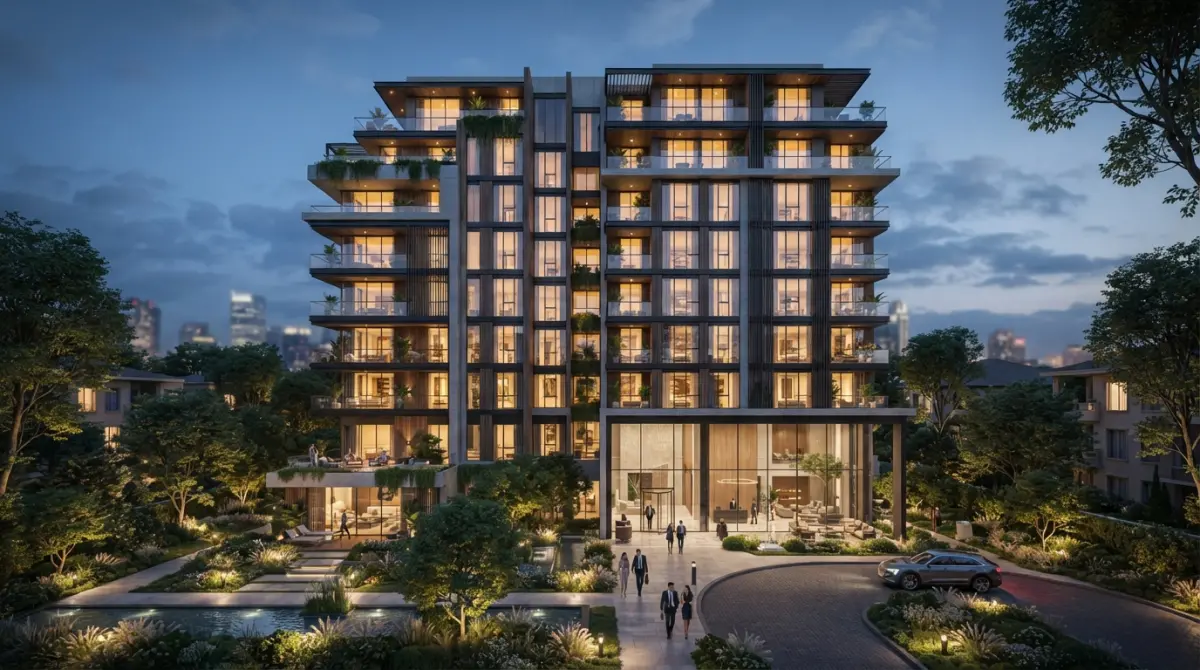
Most property crowdfunding campaigns have a pre-launch or expression of interest phase before the campaign goes fully live. This is the moment when render quality pays the biggest dividend. Developers who share polished visuals during the pre-launch phase — through email lists, social media, LinkedIn, and platform notifications — consistently build a committed audience before the fundraise opens. When the campaign goes live with that foundation already in place, early momentum is much easier to achieve.
Early momentum matters on crowdfunding platforms because most of them show campaigns sorted by percentage funded or most recently active. A campaign that raises a meaningful chunk of its target in the first 48–72 hours gets surfaced more prominently to browsers who haven’t specifically searched for it. Developers who understand this treat their pre-launch visual content as part of the fundraising strategy, not an afterthought.
Mid-campaign, renders serve a different role. At that stage, investors who are on the fence are doing more detailed due diligence. This is where interior renders, floor plans, and neighbourhood context images do their work — addressing the “but what is it actually going to be like?” questions that stall conversions.
What Developers Get Wrong With Renders for Crowdfunding
The most common mistake we see is developers repurposing planning visuals for their crowdfunding campaign without updating them. Planning renders and investor marketing visuals are not the same thing. Planning renders are typically produced to satisfy specific technical requirements — accuracy of massing, accurate material representation, correct sightlines. They’re often produced at a stage when the interior specification hasn’t been finalised, the landscaping hasn’t been designed, and the architect is still working through details.
By the time a developer is taking a project to a crowdfunding platform, they usually have far more information about the finished product. They know the specification, the finishes, the target tenant or buyer. That’s the moment to commission renders that actually reflect the sellable quality of the development — not to recycle whatever was submitted to the planning authority six months earlier.
The second mistake is producing too few renders. A single exterior image might be enough for a planning submission, but a crowdfunding campaign needs breadth. Investors browse. They want to see the building from the street, they want to see inside a representative unit, they want to understand the communal spaces if there are any. Thinking carefully about how many renders you actually need for a property development sales campaign before briefing a studio will save both time and budget — and ensure the finished package covers everything a campaign needs.
The third mistake, which is less obvious, is poor image file handling. Renders delivered at the wrong resolution or in the wrong format look compressed and low-quality on a crowdfunding platform’s image display, even when the original file was excellent. This is a production detail, but it matters.
Matching Render Complexity to Campaign Scale

Not every crowdfunding campaign needs the same visual package. A small residential conversion raising a modest sum needs a different approach to a 40-unit apartment block raising several million. Here’s a practical breakdown:
| Development Type | Recommended Render Assets | Priority |
|---|---|---|
| Single unit or small HMO conversion | 1–2 exterior renders, 1–2 interior renders of key rooms | Hero exterior first |
| Small residential scheme (5–15 units) | 2–3 exterior views, 1–2 interior renders, 3D floor plans per unit type | Exterior + floor plans |
| Medium residential or mixed-use (15–50 units) | 3–4 exterior views including aerial, 3–5 interior renders, 3D floor plans, communal space visuals | Aerial + interiors |
| Large scheme or commercial element | Full render suite including animated walkthrough or 360 virtual tour | Animation or virtual tour for investor engagement |
For larger schemes, a 3D 360 virtual tour rendering can be genuinely powerful in a crowdfunding context. It lets investors explore the development at their own pace, room by room, without any installation or specialist software. That kind of immersive experience creates a degree of investor engagement that static images alone can’t replicate — particularly for co-living, build-to-rent, or PBSA schemes where the quality of the living environment is central to the investment proposition.
The Credibility Signal That Most Developers Underestimate
There’s something else happening when a developer presents a polished set of professional renders in a crowdfunding campaign. Beyond the informational value of the images themselves, the quality of the visuals signals something about the developer. It signals organisation. It signals that they’ve invested properly in the project before asking others to invest in it. It signals that they understand what their audience needs to see.
Crowdfunding platforms do their own due diligence on developers before listing campaigns. But retail investors have no way of independently verifying track record, build quality, or delivery capability. What they can assess — often unconsciously — is whether the campaign looks like it was put together by a professional operation. High-quality renders are part of that signal. They’re not just marketing assets; they’re evidence that the developer takes the project, and the investor relationship, seriously.
This is the same logic that applies when you look at how property developers use 3D renders in crowdfunding campaigns to hit fundraising targets faster across different asset classes — from residential to commercial to specialist sectors. The underlying principle holds: professional visuals reduce uncertainty, and reduced uncertainty converts browsers into investors.
Getting the Brief Right Before You Commission
One practical note worth making. The quality of the renders you receive is directly tied to the quality of the brief you provide. Developers who hand over a full set of architectural drawings, a clear specification document, material references, and a stated view list get dramatically better results than those who share incomplete information and expect the studio to fill the gaps. It’s worth spending time on this before the project starts.
If you’re planning a crowdfunding campaign and need professional 3D visualisation that will actually convert investors, we’d be happy to talk through what your project needs. Contact us at 360archviz and we can discuss the right render package for your campaign scale, timeline, and audience.
Frequently Asked Questions
How do 3D renders help property developers attract more investors in crowdfunding campaigns?
3D renders give potential investors a photorealistic visual of a property before it's built, making it easier for them to emotionally connect with the project and understand its value. Studies show that campaigns featuring high-quality visuals can raise funding up to 40% faster because investors feel more confident committing capital to something they can clearly see and evaluate. This visual clarity reduces uncertainty, which is one of the biggest barriers to investment decisions in early-stage property projects.
What types of 3D renders are most effective for property crowdfunding campaigns?
The most effective renders for crowdfunding campaigns include exterior 3D visualizations, interior lifestyle renders, aerial drone-style CGI, and interactive 360-degree virtual tours that let investors explore the space digitally. Each format serves a different purpose — exteriors establish curb appeal and location context, while interior renders communicate quality of finishes and lifestyle aspirations. Combining two or more render types in a single campaign has been shown to significantly increase investor engagement and time spent on campaign pages.
How much do professional 3D renders cost for a property crowdfunding campaign and is the ROI worth it?
Professional 3D renders for a property development campaign typically range from $500 to $5,000 per image depending on complexity, level of detail, and the studio's reputation, with full packages including multiple views and animations potentially reaching $15,000 or more. However, when weighed against the fundraising targets — which often range from $500,000 to several million dollars — the return on investment is substantial, with many developers reporting that polished visuals directly contributed to hitting targets weeks ahead of schedule. The cost of renders is generally a fraction of one percent of the total raise, making it one of the highest-leverage marketing investments in a campaign.
Can 3D renders be used to satisfy legal disclosure requirements in property crowdfunding campaigns?
3D renders can be used as marketing visuals in crowdfunding campaigns but must be clearly labelled as 'artist impressions' or 'indicative renders' to comply with financial promotion regulations in most jurisdictions, including those governed by the FCA in the UK and the SEC in the US. They do not replace formal legal documentation such as prospectuses, investment memorandums, or planning permission drawings, which remain mandatory disclosures. Developers should always work with a legal advisor to ensure renders and campaign materials meet platform-specific and regional compliance standards before launching.
At what stage of a property development project should developers invest in 3D renders for crowdfunding?
Developers should invest in 3D renders as early as the pre-planning or planning-approved stage, ideally before launching any crowdfunding campaign, because high-quality visuals are essential for establishing credibility and generating early-bird investor interest. Launching a campaign without visual assets often results in slow initial traction, and momentum in the first 48 to 72 hours is critical to algorithmic visibility on most crowdfunding platforms. Having renders ready at campaign launch ensures developers can capitalize on early investor interest and social media shareability, which are key drivers of hitting fundraising targets faster.