Selling empty rooms or unbuilt properties is one of the greatest challenges real estate developers face. Most buyers simply cannot visualize the potential of a space when staring at bare drywall, concrete floors, or two-dimensional floor plans. To bridge this imagination gap, developers must rely on powerful visual marketing tools to evoke an emotional connection and drive sales. Two of the most popular solutions in the industry today are virtual staging and full 3D residential interior rendering.
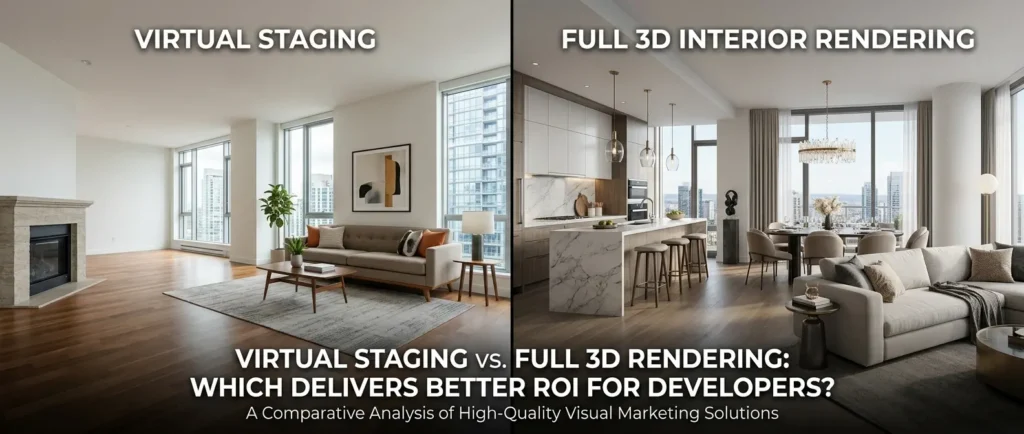
While both techniques aim to showcase a property in its absolute best light, they serve entirely different purposes and operate on distinct timelines and budgets. Virtual staging involves taking high-quality photographs of an existing, empty room and digitally superimposing furniture, decor, and lighting. On the other hand, full 3D rendering involves creating an entire space from scratch using architectural plans, long before the physical foundation is even poured. Each method has its own unique strengths, and choosing the wrong one can lead to missed opportunities or wasted marketing spend.
For developers, the decision between these two methods ultimately comes down to Return on Investment (ROI). Choosing the right visualization strategy can mean the difference between a property sitting on the market for months or selling out before construction is complete. If you are looking to maximize your marketing budget, understanding the nuances of each approach is essential. You can always explore more insights on our blog, but today we are diving deep into which visualization method delivers the best ROI for your specific development.
The Mechanics and Merits of Virtual Staging
Virtual staging is exactly what it sounds like: a digital alternative to traditional, physical home staging. Instead of renting couches, hiring movers, and paying a designer to arrange a room, developers can simply hire a photographer to shoot the empty space. A digital artist then uses specialized software to populate those photographs with highly realistic 3D furniture models, rugs, artwork, and lighting fixtures.
The primary advantage of virtual staging is its cost-effectiveness and speed. Because the physical architecture is already built and captured on camera, the digital artist only needs to focus on the interior design elements. This makes virtual staging an incredibly budget-friendly option for developers who have completed construction but need to market the final product quickly. It helps prospective buyers understand the scale of a room—proving that a king-sized bed truly fits in the master suite or that the living room can accommodate a large sectional sofa.
However, virtual staging has strict limitations. It requires an existing, finished space to work effectively. You cannot virtually stage a property that is still in the framing stage without it looking confusing or unappealing. Furthermore, while you can add furniture, you cannot easily change the physical finishes of the room. The flooring, wall colors, and window placements captured in the original photograph remain fixed.
The Comprehensive Power of Full 3D Residential Interior Rendering
Full 3D residential interior rendering is a completely different beast. Instead of starting with a photograph, 3D artists start with your architectural blueprints and CAD files. They build the entire room—walls, windows, floors, lighting, and furniture—entirely within a three-dimensional digital environment. This means the property does not need to exist in the real world for it to be marketed.
The level of control offered by full 3D rendering is unparalleled. Developers can dictate every single detail of the space. Do you want to show the living room bathed in the warm, golden light of sunset? Done. Do you want to present two different finish packages to potential buyers—one with dark hardwood floors and modern cabinetry, and another with light oak and traditional fixtures? A 3D artist can render both options flawlessly. This flexibility allows developers to target different buyer demographics with highly tailored marketing materials.
Because these renderings are built from scratch, they are the ultimate tool for off-plan sales. Developers can generate hype, secure pre-sales, and even obtain construction financing based on the stunning, photorealistic visuals of the future property. While the upfront cost of full 3D rendering is higher than virtual staging due to the immense skill and time required to build the digital environment, the marketing leverage it provides is substantial.
Analyzing the ROI: Which Strategy Wins?
When calculating ROI, developers must look beyond the initial invoice. True ROI in real estate development factors in holding costs, the speed of the sale, and the final purchase price.
Virtual staging delivers an excellent ROI for completed spec homes or flipped properties. The low upfront cost combined with the proven ability of staged homes to sell faster than empty ones makes it a highly efficient marketing tool. If your building is already finished and you simply need to get it off your books, virtual staging is the logical, high-ROI choice. It prevents the property from languishing on the market without the heavy expense of physical staging.
Conversely, full 3D residential interior rendering delivers an exponentially higher ROI for large-scale developments, luxury custom builds, and multi-family projects. The true financial magic of 3D rendering lies in its ability to facilitate pre-sales. Selling units before or during construction dramatically reduces the developer’s holding costs, loan interest, and overall risk. Furthermore, luxury buyers expect perfection. High-end 3D renderings convey a sense of prestige and quality that justifies premium pricing. The ability to command a higher asking price and secure buyers months before completion makes the initial investment in 3D rendering negligible in the grand scheme of the project’s profitability.
Practical Examples: Choosing the Right Tool for Your Project
To clearly illustrate how to maximize your ROI, let us look at a few common development scenarios and the most appropriate visual marketing strategy for each.
Scenario A: The Finished Suburban Spec Home. You have just completed a beautiful, mid-range single-family home. The walls are painted, the floors are in, but the rooms are echoing and empty. The Verdict: Virtual Staging. Since the home is ready for immediate move-in, you simply need buyers to visualize their lives there. Virtual staging will get your listing online quickly and cost-effectively, drawing foot traffic to your open houses.
Scenario B: The Unbuilt Luxury Condominium. You have broken ground on a high-rise residential building in a prime downtown location. You need to sell units to fund ongoing construction and satisfy investor demands. The Verdict: Full 3D Rendering. You cannot photograph what is not there. High-quality 3D renderings of the lobby, amenities, and individual units will serve as the cornerstone of your entire marketing campaign, allowing you to sell a lifestyle before the concrete is poured.
Scenario C: The Major Gut Renovation. You have purchased a distressed property and plan to knock down walls to create an open-concept living space. You want to list the property mid-renovation to secure a buyer early. The Verdict: Full 3D Rendering. Taking a photo of a dusty construction zone and trying to virtually stage it will only highlight the mess. A full 3D render will completely bypass the current state of the property, showing buyers the pristine, finished vision.
Conclusion: Aligning Visualization with Your Sales Strategy
Ultimately, there is no single winner in the battle between virtual staging and full 3D residential interior rendering. The strategy that delivers the best ROI depends entirely on the current lifecycle phase of your development and your target market. Virtual staging is the champion of speed and budget for completed spaces, while full 3D rendering is the undisputed king of off-plan sales and luxury marketing.
By understanding the unique benefits of each approach, developers can make strategic, informed decisions that minimize holding costs, maximize final sale prices, and keep projects moving forward profitably.
If you are ready to elevate your property marketing and want to discuss which visualization strategy will yield the highest return for your specific development, we are here to help. Please contact us to speak with our expert team. You can also explore our homepage to view our extensive portfolio of photorealistic renderings and see firsthand how we bring unbuilt spaces to life.
Frequently Asked Questions
What is the cost difference between virtual staging and full 3D interior rendering?
Virtual staging is highly cost-effective at $30 to $100 per image, offering quick ROI for already built but vacant properties. Full 3D rendering requires a larger upfront investment of $300 to $1,500+ per image but is essential for marketing unbuilt units.
When should real estate developers choose full 3D rendering over virtual staging?
Developers should use full 3D rendering during the pre-construction phase to market and pre-sell properties before ground is even broken. Virtual staging is only a viable option if the physical space is already fully constructed and ready to be photographed.
Which visualization method delivers a better ROI for pre-construction developments?
Full 3D rendering delivers the best ROI for pre-construction because it allows developers to secure early buyers and financing months before project completion. Virtual staging simply cannot be used in this phase since it relies on photographs of existing physical rooms.
How long does the process take for virtual staging versus full 3D rendering?
Virtual staging boasts a rapid turnaround time, usually requiring just 24 to 48 hours after providing the base property photographs. In contrast, full 3D residential renders typically take one to three weeks to complete due to the complex architectural modeling involved.
Also read: 3D Rendering vs Architectural Scale Models: Which is Worth the Investment for Property Developers