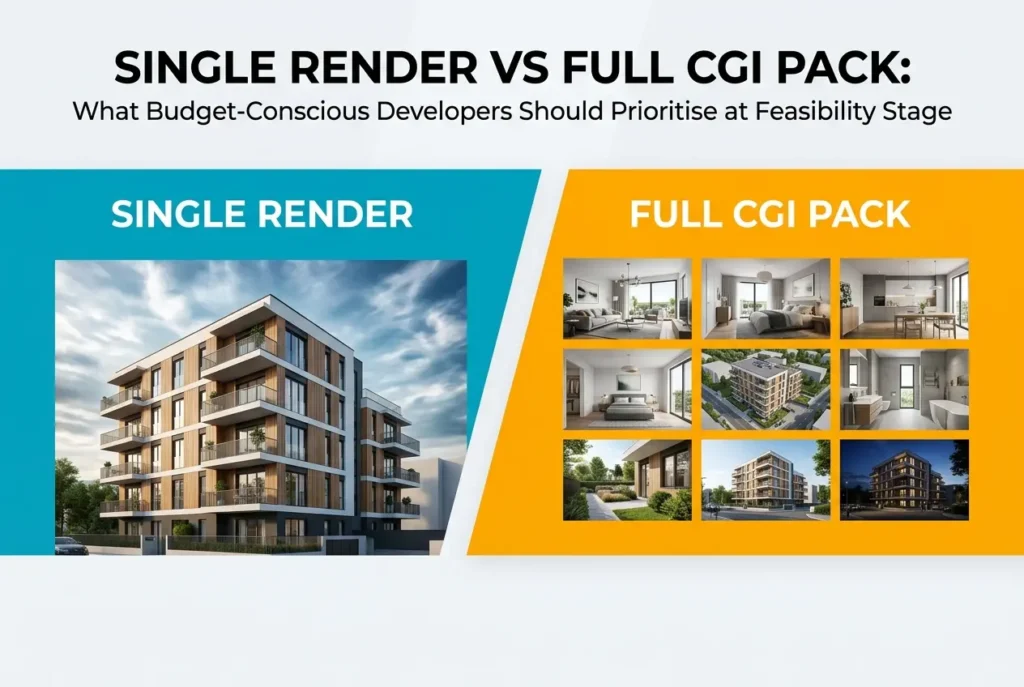
A developer called us last month with a site that hadn’t even gone to planning yet. He wanted to know if he should commission a full CGI package — exterior hero shots, interiors, floor plans, maybe a flythrough — or just get one strong image to test the waters with investors. That question comes up more often than you’d think, and it’s exactly why we’re writing this. The real answer to Single Render vs Full CGI Pack: What Budget-Conscious Developers Should Prioritise at Feasibility Stage depends less on budget and more on what decision you’re actually trying to make with the image. Feasibility stage isn’t sales stage, and treating them the same way wastes money in one direction or credibility in the other.
We’ve sat across the table from enough developers to know the instinct at this early point is usually to either go big — commission everything, cover all bases — or go minimal, because the scheme might not even proceed. Both instincts are understandable. Both are usually wrong. The right call depends on what you need the render to prove, who’s looking at it, and how far the design has actually progressed.
Single Render vs Full CGI Pack: What Budget-Conscious Developers Should Prioritise at Feasibility Stage
Feasibility stage exists to answer one question: does this scheme stack up? You’re testing viability with a lender, a landowner, a planning consultant, maybe an internal investment committee. You are not yet selling units to the public, and you are almost certainly not ready to commit to interior finishes, furniture layouts, or lighting schemes that a full CGI pack would lock you into visually.
This is the crux of the decision. A single render — one well-composed, well-lit exterior hero shot — answers “does this building look right in its context and does it read as viable” far more efficiently than a full pack does. A full CGI pack answers “will this convert buyers and investors emotionally,” which is a marketing question, not a feasibility question. Spending marketing-stage money to answer a feasibility-stage question is the single most common budget mistake we see developers make.
What a Single Render Actually Needs to Do
A single render at feasibility stage has to carry weight it wasn’t necessarily designed for. It needs to communicate massing, materiality, scale relative to neighbouring buildings, and general design intent — all in one frame. That’s a lot of pressure on one image, so the composition and angle selection matter more here than they would in a full package where multiple shots share the storytelling load.
We always push clients toward a hero angle that shows the building’s relationship to the street or site boundary, not just the building in isolation. This is where context stops being decorative and starts being functional — a planning officer or investor needs to see how the scheme sits against what’s already there. We’ve written before about why context matters in architectural rendering and how street-level surroundings and people make or break a development visual, and at feasibility stage this matters even more, because the viewer is trying to judge risk, not lifestyle.
One accurate, well-lit single render, done properly, can carry a feasibility pack further than three rushed images. If daylight and shadow accuracy matter to your site — say there’s an overshadowing concern on an adjacent property — it’s worth getting an actual sun study built into that single frame rather than guessing at lighting angles. We’ve covered this in detail in our piece on daylight simulation in architectural rendering and how accurate sun studies are helping developers beat planning objections.
What a Full CGI Pack Is Actually For
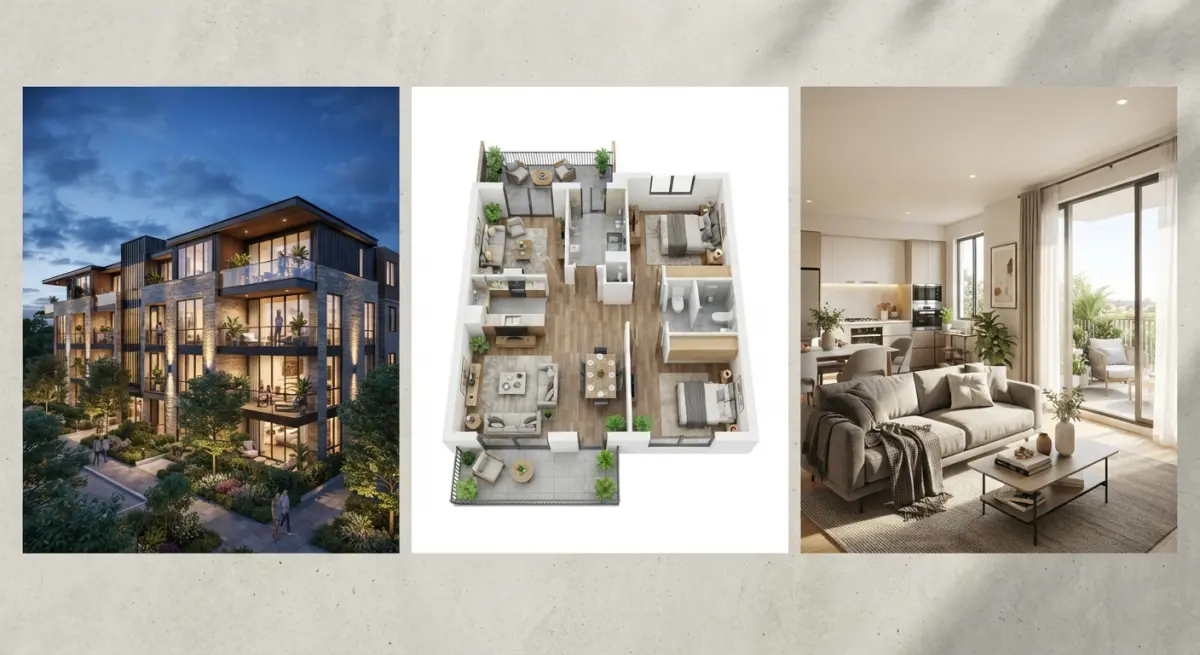
A full CGI pack — multiple exterior angles, interior shots, floor plans, maybe an aerial view or a walkthrough — exists to sell. It’s built for a moment when you need to convert interest into deposits, or convince an institutional investor to commit capital based on lifestyle appeal and finish quality, not just numbers on a spreadsheet.
The problem at feasibility stage is that a full pack assumes design certainty you often don’t have yet. Interior finishes, kitchen layouts, bathroom tiling — none of that should be locked in before planning is secured, because planning conditions or value engineering can force changes. We’ve seen developers commission a full interior CGI set before planning submission, only to redo half of it after the planning committee requested amendments to floor-to-ceiling heights. That’s money spent twice.
If you do need interiors early — for instance, to secure early investment for a residential scheme — it’s worth understanding how residential developers use interior renderings to sell off-plan properties before construction starts, because that process assumes a design freeze that feasibility-stage projects usually haven’t reached yet.
A Practical Comparison
| Factor | Single Render | Full CGI Pack |
|---|---|---|
| Best suited for | Feasibility studies, internal sign-off, early investor conversations | Sales launches, marketing campaigns, off-plan buyer conversion |
| Design certainty required | Low — massing and materials can still shift | High — finishes and layouts should be locked |
| Typical audience | Lenders, planning consultants, internal boards | Buyers, agents, institutional investors, marketing teams |
| Risk if design changes later | Low — one image to redo | High — multiple assets may need rework |
| Turnaround | Faster, often within days | Longer, weeks depending on scope |
Where Developers Get This Wrong

The most common mistake isn’t choosing the wrong option outright — it’s timing. We regularly get briefs for full packages before a scheme has even been through pre-application discussions with planning. The developer wants to “have everything ready,” but half of what gets produced ends up obsolete once the design evolves through the planning process.
The opposite mistake happens too. A developer commissions one render for feasibility, it gets approved internally, and then they try to stretch that same single image across a crowdfunding campaign or early marketing push. A feasibility render is composed to answer viability questions — it’s rarely composed the way you’d want for a campaign that needs to hit fundraising targets. If you’re planning to raise capital publicly, it’s worth reading how property developers use 3D renders in crowdfunding campaigns to hit fundraising targets faster before you assume one asset can do both jobs.
Another pattern we see: developers assume a full CGI pack automatically means better quality. It doesn’t. Quality comes from the level of detail matched to the design stage, not from volume of images. A single render built from a design that’s still at concept mass model level shouldn’t be rendered at the same finish detail as a scheme with confirmed materials and glazing specs. Understanding what level of architectural detail you actually need in a 3D rendering — from LOD 100 to LOD 400 — helps set expectations before you brief the studio, so you’re not paying for polish the design stage doesn’t support yet.
How to Decide, Practically
Ask these questions before you brief anyone:
- Who is the primary audience — a lender, a planning committee, or the public?
- Is the design frozen enough that interiors and materials won’t change in the next few months?
- Do you need this asset again later for marketing, or is it purely internal?
- Is there a specific viability question — overshadowing, massing, street context — that one strong image can answer on its own?
If most answers point toward internal decision-making and design uncertainty, one render, done well, is the right call. If you’re already past planning, finishes are confirmed, and you’re moving toward sales or investor presentations, that’s when a full pack starts to earn its cost. For larger or mixed-use sites, this decision gets more complex — those often benefit from an aerial view early on to establish site context, which you can explore further in our guide on aerial rendering vs site plan drawings and what mixed-use developers are using to get schemes approved faster.
Getting the Brief Right Either Way
Whichever route you choose, the biggest cost driver isn’t the number of images — it’s how well you brief the studio. A poorly briefed single render can cost more in revisions than a well-briefed full pack. We always recommend developers read through our notes on how to brief a 3D rendering studio and what architects and developers need to prepare before project kickoff before committing to either option, because clarity upfront is what actually keeps feasibility-stage costs under control.
Budget discipline at feasibility stage isn’t about spending less — it’s about spending on the right question at the right time. A single render that clearly answers a viability concern is worth more than a full package that looks impressive but arrives at the wrong moment in your design process. If you’re not sure which side of that line your project sits on, talk to us before you commission anything. Get in touch through our contact us page and we’ll help you figure out exactly what your feasibility stage actually needs.
Frequently Asked Questions
What is the difference between a single CGI render and a full CGI pack for property developments?
A single render is one high-quality still image typically showing the exterior or a key view of a development, used for marketing or planning purposes. A full CGI pack includes multiple images such as aerial views, street-level perspectives, interior visuals, floor plans, and sometimes animations, providing a comprehensive visual suite for sales and planning submissions.
How much does a single CGI render cost compared to a full CGI pack?
A single render typically costs between £300-£800 depending on complexity, while a full CGI pack can range from £1,500 to £5,000+ depending on the number of images and scope required. At feasibility stage, developers often start with a single render to test viability before committing budget to a full pack.
Is a single render enough for a planning application at feasibility stage?
In many cases, a single high-quality render can support initial feasibility discussions and pre-application planning enquiries, especially for smaller schemes. However, larger or more complex developments may require additional views to satisfy local planning authority requirements, so it's worth checking with your planning consultant early.
When should developers invest in a full CGI pack instead of a single render?
A full CGI pack becomes worthwhile once a scheme has secured planning permission or is moving into the marketing and pre-sales phase, where multiple visuals help attract investors and buyers. For early-stage feasibility studies, a single render is usually sufficient and more cost-effective for testing design concepts and stakeholder buy-in.
What factors should budget-conscious developers consider when choosing between a single render and a full CGI pack?
Developers should weigh the project stage, purpose (internal feasibility review vs external marketing), and audience (planners, investors, or buyers) before deciding. Starting with a single render allows for cost control and iterative design testing, while a full CGI pack should be reserved for when the project is ready for wider promotion and sales.