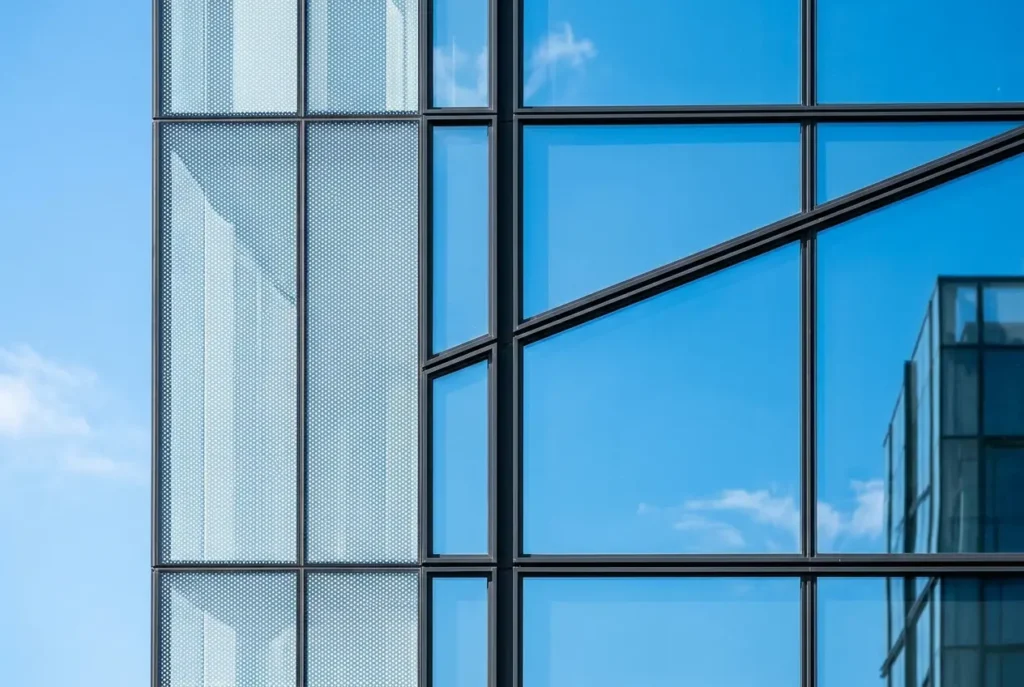
Glass is the material clients trust us with most and forgive least. A tower with a flat, mirror-like blue skin looks fake within seconds, yet a facade with too much noise looks cheap. Knowing How to Render Glass Facades Accurately: Reflections, Fritting and Curtain Wall Detail in Commercial Exterior Visuals comes down to understanding what real glazing does with light, then building that behavior into the scene instead of faking it with a tint.
Most weak facade renders fail for the same reason: someone treated the glass as a single colored surface. Real curtain walls are assemblies. They have coated glass, spandrel panels, mullions, gaskets, shadow boxes, fritted zones and slab edges sitting just behind the surface. Each of these reads differently, and the differences are what make a building feel built.
Below is how we approach it in our studio, what we’ve seen go wrong, and what to give your rendering team so the result matches the project you are designing.
Start With the Glass Build-Up, Not a Color
The first question we ask is what the glazing spec actually is. Is it a double or triple insulated unit? Low-E coated on which surface? Is it clear, low-iron, or tinted? A low-iron glass reads cleaner and slightly cooler, with almost no green edge. Standard clear glass shows a green tint when you look through its edge or at steep angles. Bronze or grey tints change the whole mood of the building.
In the renderer, we build glass with proper index of refraction, thin-walled behavior where appropriate, and a coating response that shifts reflectivity with viewing angle. That angle response is the Fresnel effect: glass looks more transparent when viewed straight on and more mirror-like at glancing angles. A facade photographed from street level, looking up, will be far more reflective than the same facade seen head-on. If your render looks equally reflective everywhere, something is off.
Vision glass versus spandrel
Floor-to-floor, a curtain wall alternates between vision glass and spandrel zones that hide slab edges, ducts and structure. Spandrel glass is usually opaque-backed, so it reflects the sky but shows no interior. Vision glass lets the viewer see in, but how much depends on the lighting balance. We model both with distinct materials. Spandrel often looks slightly darker and flatter than vision glass, and that subtle difference gives a facade its rhythm.
Reflections: What Is Being Reflected Matters More Than the Glass

A glass facade is only as convincing as the environment it reflects. An empty HDRI sky on a glass tower gives you a sterile, computer-generated look. Real facades pick up neighboring buildings, trees, street activity, clouds and even the horizon line.
Our checklist for reflection context:
- Surrounding massing. Even rough proxy buildings placed outside the camera view give the glass something to mirror. Without them, the lower floors reflect nothing but sky.
- Sky with structure. Clear gradients look fake. Soft cloud breakup creates variation across panels and keeps large surfaces from reading as flat.
- Ground-level reflections. Lower floors should show street, trees and pavement. The upper floors shift toward sky. That vertical transition is one of the clearest signs of realism.
- Slight panel variation. Real glass is not perfectly flat. Thermal stress and installation tolerance cause slight distortion. A very small variation in panel normals breaks up mirror-perfect reflections in a way the eye reads as real.
A mistake we see in client-supplied references is a demand for “crystal clear, perfectly sharp reflections” on a 40-story tower. Real buildings of that scale almost never look like that. We usually soften the effect so the building reads as a believable object and not a polished mirror.
Fritting, Patterns and Surface Detail

Fritted glass is where accuracy gets tested. A ceramic frit is a pattern of fired enamel dots or lines applied to the glass, used for solar control, bird safety or visual privacy. In a render, frit has to behave like a physical coating, not like a texture stuck on a plane.
We handle it in a few ways. The pattern is mapped at true scale, so dot size and spacing match the drawings. The frit sits on the correct glass surface, which matters because a coating on surface two of an insulated unit looks different from one on surface four. It reads as semi-opaque, with light passing through the gaps and the enamel catching light on the face. Gradient frits, which fade from dense to sparse, need careful mask work so the transition doesn’t band.
Viewing distance changes everything. From far away, frit blends into a soft tonal shift, almost like a change in tint. Up close, individual dots appear. If we render a distant aerial with sharply visible dots, it will look wrong and may produce moiré. We tune pattern filtering so the effect holds at each camera distance.
Curtain Wall Detail: Mullions, Gaskets and Depth
This is the part that sells the building as a real system. Flat glass with thin lines drawn between panels looks like a diagram. Real curtain walls have depth: pressure plates, caps, exposed fixings, shadow lines and sometimes deep fins or louvers.
Here is what we model and why:
- Mullion profiles. We use the actual extrusion shape if the architect provides it. Even a simplified profile with correct depth catches light and casts a shadow line that a flat strip never will.
- Metal finish. Anodized aluminum, powder-coated and PVDF finishes each have a different reflectivity and micro-roughness. A slightly brushed, imperfect finish looks more real than pure chrome-like metal.
- Interior visibility. What can be seen behind the glass: ceiling lines, slab edges, blinds, lighting. We usually build a simplified interior so the building doesn’t look like a hollow shell.
- Corners and terminations. Parapets, base conditions and corner joints are where fake facades reveal themselves. Getting these right shows craft.
For clients who need the facade to communicate with precision, such as at planning or tender stage, we suggest pairing hero shots with close-up detail views. Our 3D exterior rendering services are set up for this kind of layered output, from full-building views to façade-level close-ups.
What Clients Get Wrong, and What Works in Practice
After many commercial exterior projects, a few patterns repeat.
Sending a color swatch instead of a spec. “Blue glass” tells us very little. A manufacturer’s product name, coating type, or a physical sample photo lets us match transmission and reflectivity far more accurately. If the spec isn’t final, tell us. We can show two glazing options side by side so the decision gets made before it is expensive.
Expecting see-through glass in every shot. In daylight, exterior glass mostly reflects. You see inside clearly at dusk, when interior lights come on and the balance flips. If you want occupied floors and a visible interior, a twilight view is the right call, and it often makes the strongest marketing image for a commercial building.
Ignoring the sun position. Glass facades behave very differently with the sun hitting them directly versus sitting in shade. We often test a few lighting setups early, because a side-lit facade can reveal mullion depth and frit patterns, while a front-lit one flattens them.
Over-correcting in post. Heavy Photoshop reflections pasted over a render rarely survive close inspection. Getting the reflections right in the 3D scene is more reliable, and it keeps variations like day and night consistent.
One practical tip: give us the elevation drawings and a section through a typical bay. That single section tells us glass build-up, mullion depth and spandrel position, which saves rounds of revisions.
Conclusion
Accurate glass comes from treating a facade as a layered system: a correct glazing spec, believable reflections, properly scaled frit and real depth in the curtain wall. Skip any of those and the building drifts toward looking like a model. Get them right and the render communicates materials, scale and quality before anyone reads a spec sheet.
If you have a commercial project with a glass-heavy facade and want it visualized with this level of care, explore our 3D exterior rendering services or send us your drawings and glazing details. We’ll tell you honestly what the facade needs to look right.
Frequently Asked Questions
How do I make glass facades look realistic in architectural renders without them appearing like mirrors?
Blend reflection with transmission by using a physically based glass material with a Fresnel falloff, so reflectivity rises at grazing angles and the interior shows through at steeper angles. Add subtle interior elements such as ceiling grids, floor slabs, blinds and lighting, and slightly tint the glass (usually a green, blue or grey cast) to match the real product. Keep reflection roughness very low but not zero, and use a believable HDRI or modeled surroundings so the reflections carry context.
What is the best way to render ceramic fritting on glass curtain wall panels?
Create the frit pattern as a high-resolution black-and-white opacity or mask map at the correct real-world scale, then use it to drive opacity, diffuse color and roughness on the glass material. Map it with accurate UVs so dot size and spacing match the manufacturer's specification, and apply it only to the correct surface (typically surface #2 or #3). Frit should look matte and slightly translucent against the glossy glass, so vary roughness between the fritted and clear areas.
How much curtain wall detail (mullions, spandrels, gaskets) do I need to model for commercial exterior visuals?
Model the mullions, transoms, pressure plates, spandrel panels and shadow boxes at least for close and mid-range views, since these elements create the depth, shadow lines and rhythm that make a facade read as real. For distant shots, you can simplify the geometry as long as the profile depths and panel proportions are correct. Small details like gasket lines, slight panel misalignments and visible fixings can be added with bump maps or instanced geometry to avoid heavy scene weight.
Which reflections should I use for glass facades: HDRI, modeled surroundings, or both?
Use both for the most convincing result: an HDRI provides realistic sky gradients and lighting, while modeled or projected neighboring buildings, trees and street elements give the glass specific, believable reflections. Pure HDRI reflections often look empty at street level, where a glass facade would actually reflect nearby context. Control reflection strength by composing the sky so it doesn't overpower the facade, and add slight variation between panels to simulate minor glass flatness differences.
How can I avoid common mistakes like flat, overly clean, or noisy glass renders in V-Ray, Corona, or Lumion?
Avoid flat results by adding variation: slight differences in panel tint and reflectivity, subtle dirt or streaking near the edges, and visible interior depth behind the glass. To reduce noise, use proper glass settings, such as a single-surface or thin-wall approach instead of fully refractive solid glass for large facades, and enable denoising and adequate sampling for reflections. Finally, check the glass IOR (about 1.5), the exposure balance between interior and exterior, and the post-production contrast so reflections remain visible but don't wash out the building.