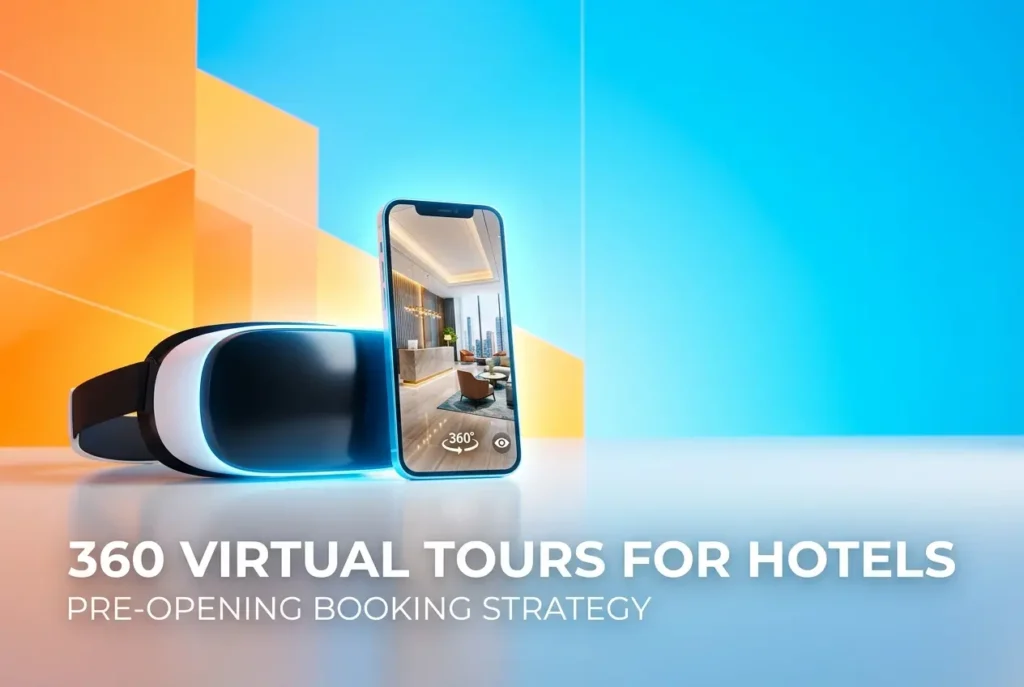
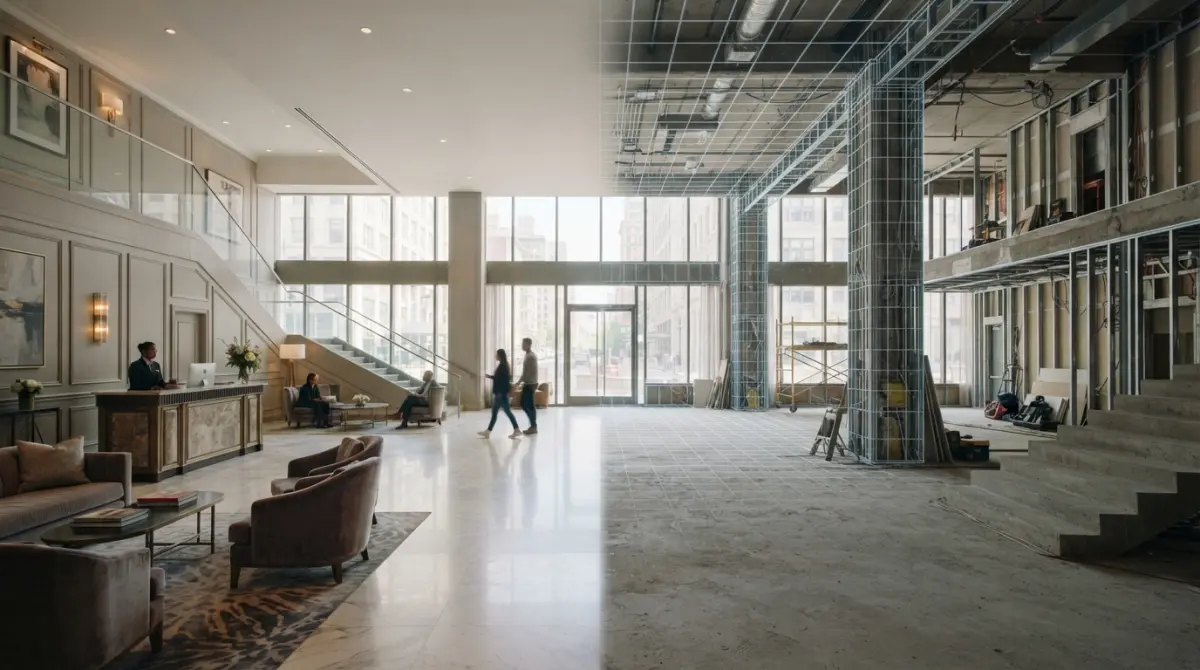
A hotel that hasn’t opened yet has a strange problem: it needs guests, but there’s nothing to stay in. Sales teams, wedding planners, corporate travel buyers and booking platforms all want to see the product, and the product is still a concrete shell and a stack of drawings. This is where 360 Virtual Tour Rendering for Hotel Pre-Opening Campaigns: How Hospitality Groups Fill Bookings Before Doors Open earns its place in the marketing budget. A well-built tour lets someone stand in the lobby, walk to the pool deck, and check the view from a corner suite months before the paint is dry.
Stills matter, and we still produce plenty of them. But a still shows one decision made by one camera. A 360 tour lets the buyer choose where to look, and that sense of choice builds trust. People book what they feel they’ve already seen.
In this post I’ll cover what a hotel pre-opening tour actually needs, how we build them, where campaigns go wrong, and how to get the most from the finished assets once they exist.
Why Hotels Sell Differently Than Other Property Types
A residential developer sells a floor plan and a view. A hotel sells an experience, and experiences are harder to picture. Guests are comparing your unbuilt property against competitors that have years of real photography and thousands of reviews. You have nothing to match that, so your visuals have to carry far more weight than they would for an apartment block.
The audience is also split. Leisure bookers want to know whether the room feels romantic or cramped. Event buyers want to know how the ballroom flows into the pre-function space. Corporate travel managers care about the lobby, the business lounge and the walk from elevator to room. A single hero image can’t answer all of that. A navigable tour can.
What a Pre-Opening 360 Tour Should Actually Include
Most briefs we receive start with “the lobby and a few rooms.” That’s a reasonable start, but it rarely matches how people decide. Think in terms of the guest journey instead.
- Arrival and lobby: the first impression, including the check-in desk, lounge seating and signage.
- Each distinct room type: not just the flagship suite. If you’re selling a standard king, show the standard king.
- Signature amenities: rooftop bar, spa, pool, restaurant. These are the reasons people choose one property over another.
- Event spaces: ballrooms and meeting rooms, ideally shown in more than one layout.
- Views: balcony and window views rendered from the correct floor height and orientation.
Views deserve special mention. A room tour that shows a generic skyline is a liability. If the guest arrives and the real view is a parking structure, you have a complaint on day one. We build view plates from actual site context, massing of neighbouring buildings and the correct elevation, so the tour is honest as well as attractive.
How We Build a Hotel Tour: The Technical Side
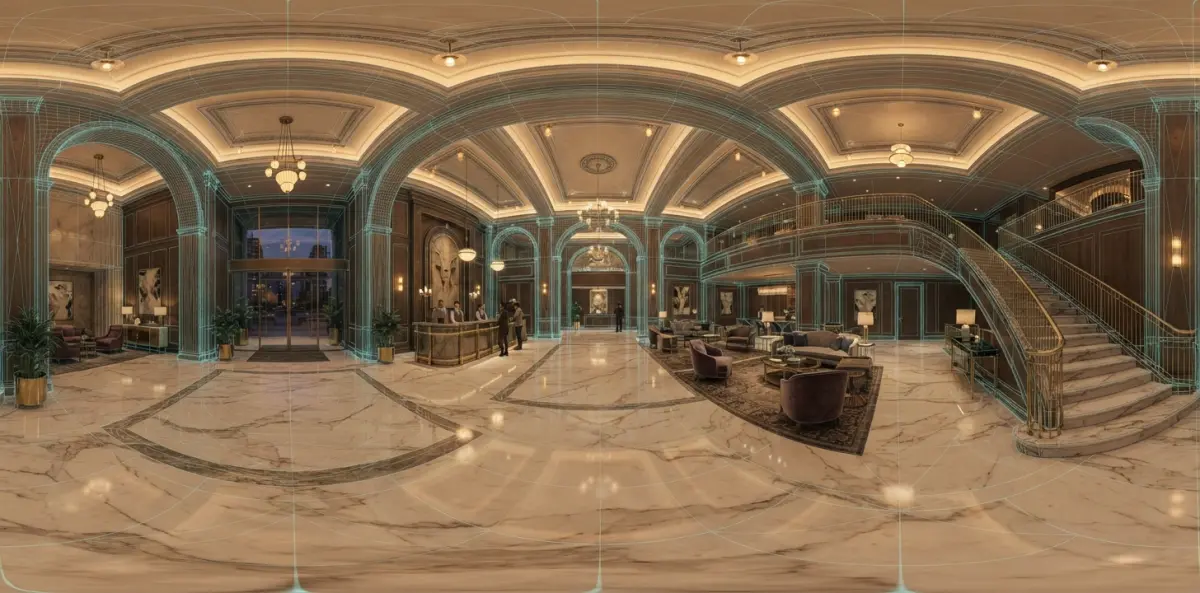
A 360 tour is a set of panoramic renders, each from a fixed camera position, linked together with hotspots. Each panorama is rendered as an equirectangular image, a flat 2:1 picture that wraps onto a sphere inside the viewer. The look is only as good as the scene behind it.
Camera placement
Panorama positions are the most underrated decision in the whole process. Place the camera at roughly eye height, around standing level, and avoid putting it too close to walls or furniture, because the sphere distorts anything near the lens. In a hotel room, we typically choose a position that shows the bed, desk and window in one turn without making the room look either cavernous or tiny. Wide spaces like lobbies need several linked nodes so the guest can move naturally rather than teleporting between unrelated points.
Lighting and materials
Hotels are sold on atmosphere, and atmosphere is lighting. We usually render the main spaces in at least two conditions: daylight and evening. A lobby bar that looks flat at noon can look exceptional with warm pendants and a dimmed ceiling. Materials need to hold up under close inspection too, because in a 360 view the viewer can stop and look at the marble veining, the fabric weave on the headboard, the grout lines. Soft furnishings in particular need proper modelling, since fabric that looks like plastic is the quickest way to make a luxury property look cheap.
Resolution and delivery
A panorama has to be sharp when the viewer zooms in, so the source images are much larger than a standard still. These files then need to be optimised so the tour loads quickly on a phone with an average connection. A beautiful tour that takes ten seconds to load on mobile will lose most of its audience. We tile and compress the panoramas so the viewer loads a low-resolution version first and sharpens as the guest looks around.
If you want to see how this kind of work is structured end to end, our 360 virtual tour rendering services page walks through the process.
Where Hospitality Groups Use the Tour Before Opening
The tour is not a website ornament. It’s a sales tool that works across several channels at once.
| Channel | How the tour is used |
|---|---|
| Hotel website | Embedded on room pages and a dedicated “explore the hotel” page |
| Group and event sales | Sent to planners to show layouts and capacity before a site visit is possible |
| Travel trade partners | Shared with agents and tour operators who need to describe the product accurately |
| Sales gallery or pop-up | Displayed on a VR headset or large touchscreen for investors and branded residence buyers |
| Social and paid campaigns | Cropped views and flat-screen walkthrough clips pulled from the same scene |
That last row is where the economics improve. Once the 3D scene is built, you can pull stills, animated flythroughs and social content out of the same model. Our 3D architectural animation work often starts from the same assets, so the lobby you’ve already approved becomes a cinematic opening shot without being rebuilt.
What Clients Get Wrong
After working on hospitality projects, certain mistakes come up again and again.
Starting before the design is locked. Hotels change late. Furniture packages get swapped, a wall finish is replaced, the restaurant layout is revised. If rendering starts while the FF&E selections are still in flux, you pay for rework. We’d rather wait for a frozen interior package, even if that costs a few weeks, than rebuild six rooms.
Over-styling. It’s tempting to fill every room with props: flowers, trays, folded towels, books. In a 360 view the guest sees everything, so clutter gets obvious fast. Style with restraint, and keep the room looking like something a real person could actually use.
Ignoring scale cues. If a suite is meant to feel generous, the proportions must be accurate. Wide-angle distortion can make a small room look large in a still, but a 360 panorama is much less forgiving and a guest who feels misled will remember it. We build from the architect’s real dimensions and keep the field of view honest.
Treating the tour as one deliverable. The strongest campaigns plan the tour, stills and short video together from the start, because the same camera decisions and lighting setups serve all three. Our 3D interior rendering team often builds the room-level scenes first so they can feed every format.
Forgetting a call to action. A tour that ends with no way to book is a missed opportunity. Place a booking or enquiry button inside the viewer itself, on the room-type hotspots especially.
Keeping the Tour Honest as Construction Progresses
A pre-opening tour is a promise, and the finished building should keep it. Treat the 3D model as a living reference. When construction changes a detail, update the scene so the marketing assets match what’s being built. Once the hotel opens, many groups replace the rendered panoramas with photographic ones, and a consistent node layout makes that swap easy. Plan for it from the beginning by keeping camera positions in the same places the photographer will later stand.
A Practical Starting Point
If you’re planning a launch, here is how I’d scope it. Begin with the lobby, one example of each room type, and your two or three headline amenities. Add event spaces if group business matters to your revenue model. Render day and evening for the spaces where mood is the selling point. Then test the finished tour on a mid-range phone before anyone signs off, since that’s how many of your guests will see it.
Getting 360 virtual tour rendering for hotel pre-opening campaigns right is mostly about discipline: frozen designs, honest views, sensible camera positions and fast loading. The visuals do the persuading, but only if the groundwork is solid.
If you have a hotel project coming up and want to talk through scope, timelines or budget, explore our 360 virtual tour service or send us your drawings and we’ll tell you honestly what the project needs.
Frequently Asked Questions
How much does a 360 virtual tour rendering cost for a hotel that hasn't been built yet?
Pricing typically ranges from $150 to $500 per rendered 360 panorama, depending on resolution, level of detail, and revision rounds. A full hotel package covering a lobby, several room types, restaurant, pool, and amenities usually runs $3,000 to $15,000. Costs rise with custom furniture modeling, interactive hotspots, and booking-engine integration.
How early before opening should a hotel launch a 360 virtual tour for pre-opening bookings?
Most hospitality groups launch the tour 6 to 12 months before opening, once architectural plans and interior design finishes are approved. This gives enough time to build the tour into the website, run paid campaigns, and sell group, wedding, and corporate blocks. Launching early also lets you collect waitlist signups and founding-guest offers well ahead of the opening date.
Can a rendered 360 virtual tour be embedded in a hotel website and linked to the booking engine?
Yes, most 360 rendering platforms provide an iframe or JavaScript embed that works on standard hotel websites and CMS platforms like WordPress. You can add clickable hotspots on room views that link directly to specific room types or rate pages in your booking engine. This shortens the path from exploring a room to reserving it, which improves pre-opening conversion.
How accurate are 360 renderings compared to the finished hotel, and could they mislead guests?
Renderings built from final architectural drawings, material specs, and approved FF&E schedules can be very close to the finished property. To avoid misleading guests, hotels should update the tour after construction changes and add a disclaimer such as 'artist's rendering, final finishes may vary.' Replacing renders with real photography at opening maintains trust and keeps reviews consistent.
What results can hotels expect from using 360 virtual tours in pre-opening marketing campaigns?
Hotels often report longer time on page, higher inquiry rates, and stronger engagement from meeting planners, wedding clients, and travel agents who need to visualize spaces before committing. Immersive visuals help sell group blocks and early reservations when no physical site visits are possible. Results vary, so track metrics like tour completion rate, click-through to booking, and pre-opening revenue to measure ROI.