Every mid-size architecture practice hits the same moment. The visualization queue is overflowing, a competition deadline is two weeks out, and someone in the partner meeting says, “Why don’t we just buy the software and do this ourselves?” It’s a fair question. The honest answer is in In-House Rendering Software vs Outsourcing to a Studio: A Total Cost Comparison for Mid-Size Architecture Practices, and it rarely comes down to what a license costs.
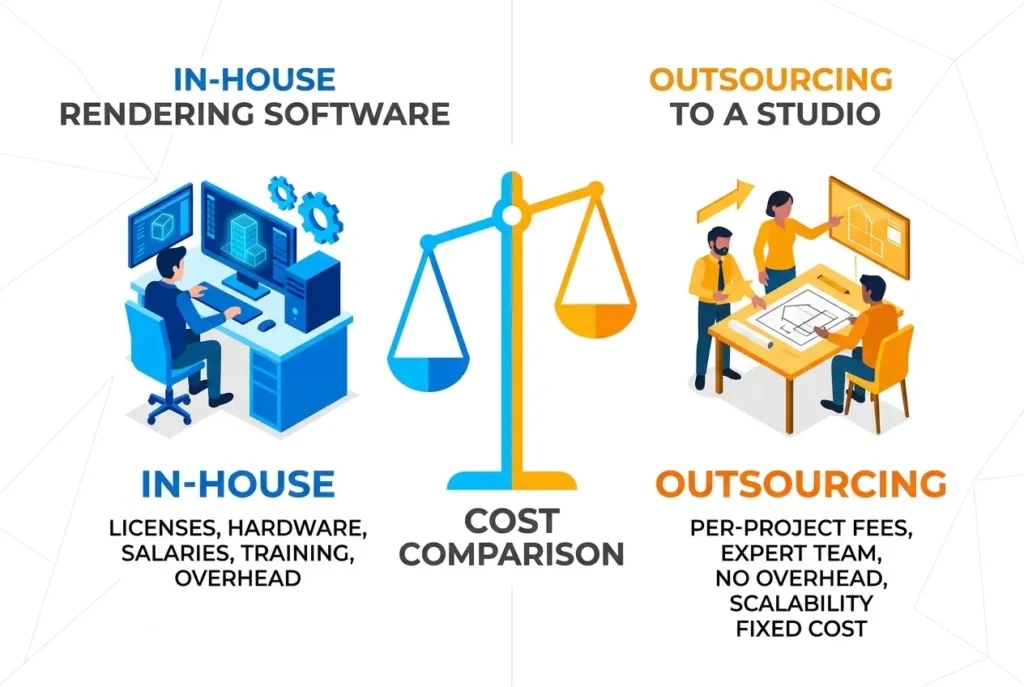
Software is the cheapest part of in-house rendering. The expensive parts are hardware, salaries, training time, idle capacity, and the cost of mediocre images going out under your firm’s name. Outsourcing has its own hidden costs too, mostly around briefing quality and revision management.
I’ll break down both sides the way we see them from the studio floor, where we work with practices on both models and sometimes both at once.
What In-House Rendering Actually Costs
Start with the visible line items. You need rendering software (V-Ray, Corona, Lumion, Enscape, Unreal Engine, or D5, depending on your pipeline), plus modeling software, plus plugins for scattering, vegetation, and post-production. Most of these are subscriptions now, so they recur every year whether you render or not.
Then hardware. A workstation that can handle a dense exterior scene with scattered vegetation, high-poly furniture, and a 6K output is not a standard office machine. You need a strong GPU or CPU (depending on engine), plenty of RAM, and fast storage. Those machines also age. A render box that feels fast now will be struggling with your scenes in a few years, and you will pay for replacement again.
The biggest cost, though, is people. A competent visualization artist is a specialist: lighting, materials, composition, photography principles, color grading, and enough architectural literacy to read your drawings. If you hire one person, you’ve created a single point of failure. When they’re sick, on leave, or resign, your visualization capability disappears overnight.
The Costs People Forget
- Ramp-up time: Even good hires need weeks to learn your file standards, libraries, and design language.
- Asset libraries: Quality furniture, trees, people, and materials are either bought or built. Both take money or time.
- Idle capacity: Architecture work is lumpy. Competition season is chaos, then there are quiet weeks. You pay salary through both.
- Architect time diverted: When a designer “just does a quick render,” that’s billable design time going into a task they’re not specialized in.
- Render time: Machines tied up overnight mean fewer iterations and slower feedback loops.
What Outsourcing Actually Costs
Outsourcing converts a fixed cost into a variable one. You pay per image, per animation, or per project, and when there’s no work, you pay nothing. For a practice with uneven demand, that matters a lot.
The studio carries the software licenses, the render farm, the asset libraries, and the team. You get a lighting specialist, a modeler, and a post-production artist working on the same image rather than one generalist doing everything. That division of labor is why a good studio can turn around work that would swamp a single in-house hire.
The costs on the outsourcing side are different. You’ll spend time preparing drawings, references, and material specifications. You’ll spend time reviewing drafts. If your brief is vague, you’ll pay for revision rounds. And if you choose a studio on price alone, you may pay twice when the first batch isn’t usable.
Side-by-Side: Where the Money Goes
| Cost Factor | In-House | Outsourced |
|---|---|---|
| Software licenses | Annual, regardless of use | Included in project fee |
| Hardware | Capital cost plus replacement cycle | Studio’s responsibility |
| Staffing | Fixed salary, benefits, training | Pay per project |
| Peak demand | Bottleneck or overtime | Studio scales the team |
| Quiet periods | Paying for idle capacity | No cost |
| Turnaround on small edits | Fast, internal | Depends on revision terms |
| Design control | Very high | High with a clear brief |
| Risk of skill gaps | High with one or two artists | Low, team covers specialties |
The Break-Even Question
I won’t give you a magic number, because it doesn’t exist. What I can give you is the logic. In-house makes financial sense when your visualization workload is steady, high-volume, and predictable enough to keep a dedicated artist (or a small team) busy most of the year. Think of a practice producing regular marketing imagery, planning submissions, and design-development views across many concurrent projects.
Outsourcing wins when your needs are spiky, when you need specialized output like animation or large-scale masterplan imagery, or when you only need hero images for key milestones. For many mid-size practices, the work is a mixture, and that points toward a hybrid.
The Hybrid Model Most Practices Land On
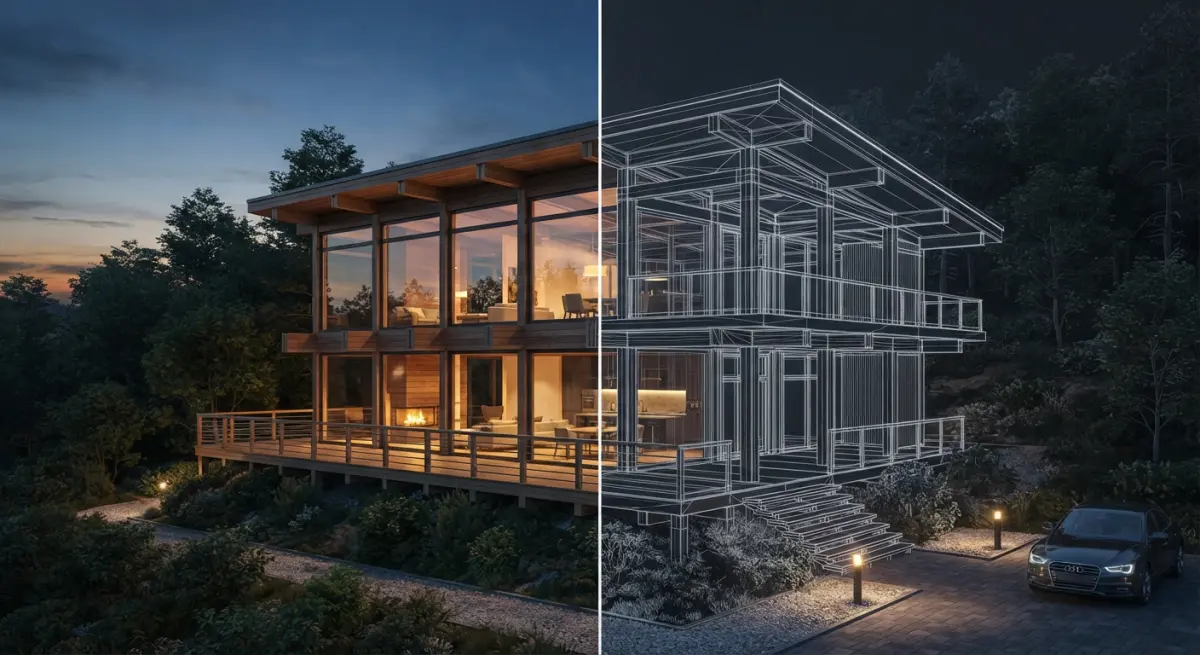
The smartest setups we see keep quick, internal visualization for design development. Real-time tools like Enscape, Twinmotion, or D5 are great for testing massing, daylight, and materials while the design is still moving. Nobody should pay a studio for work that will be obsolete by Thursday.
Then, when the image has to sell something (a competition board, a planning application, a client presentation, a marketing brochure), it goes to a studio. That’s where lighting, atmosphere, and storytelling matter, and where a specialist team produces a different level of finish. If you want to see what that tier looks like, our architectural rendering services are built around exactly this handoff.
What Clients Get Wrong
They compare license price to project price. A software subscription is not a rendering capability. It’s a tool. Comparing it to a finished image ignores the skill, hardware, and time needed to turn a model into something persuasive.
They assume real-time equals final quality. Real-time engines have improved enormously, and they’re excellent for design review. But for hero stills, you often still want a path-traced workflow with controlled lighting, careful camera work, and hand-finished post-production. They’re different tools for different jobs.
They hand over weak briefs. The biggest cause of outsourcing frustration is a brief that says “make it look nice.” Good briefs include camera positions, time of day, materials, landscaping intent, and a few references for mood. A clear brief cuts revision rounds more than any other single thing you can do.
They underestimate the model. If your BIM or CAD model is messy, whether in-house or outsourced, someone has to clean it. Duplicate geometry, flipped normals, and inconsistent layers all cost time. We’ve seen this slow projects regardless of who was doing the rendering.
They forget consistency. One in-house artist produces a consistent look. A rotating cast of freelancers doesn’t. If you outsource, pick one studio and stay with them so your portfolio keeps a recognizable visual identity.
A Practical Way to Decide
Run a simple audit over the last twelve months. Count how many images, animations, and revisions your practice actually needed, and when. Note which were rushed, which were client-facing, and which were internal. Then ask:
- Was the demand constant or did it come in bursts?
- How much designer time went into producing visuals?
- Did any deliverables fall below the quality your pitches deserved?
- Would a single in-house hire have covered the peaks, or just the average?
If the answers show bursts, quality gaps, and designers stuck rendering, you’re probably paying more for in-house than you think. If the work is steady and mostly iterative, building a small internal team is reasonable.
Final Thoughts
There’s no universally cheaper option. In-house gives you speed and control but locks in fixed costs and key-person risk. Outsourcing gives you flexibility and specialist quality but demands good briefing and a studio you trust. For most mid-size practices, a hybrid built on real-time internal tools and studio-grade final imagery gives the best return.
If you’re weighing the options for your own practice, we’re happy to look at your workload and tell you honestly which model fits. Get in touch with our team and send over a current project, and we’ll walk you through what a studio workflow would look like alongside your existing process.
Frequently Asked Questions
How much does in-house architectural rendering software cost per year for a mid-size practice?
Software licenses typically run $2,000-$8,000 per seat annually (e.g., V-Ray, Enscape, Lumion, or Twinmotion plus 3ds Max or Revit add-ons). Add $4,000-$10,000 per workstation for GPU-equipped hardware refreshed every 3-4 years, plus salary for a visualization specialist ($60,000-$95,000). Most mid-size firms spend $80,000-$150,000 per year for a small in-house team once training and IT overhead are included.
How much does it cost to outsource architectural renderings to a visualization studio?
Still exterior images generally cost $500-$3,500 each, interiors $400-$2,500, and animations $3,000-$15,000+ depending on length and complexity. Revisions, rush fees, and large packages for competitions or planning submissions can raise totals significantly. A firm producing 40-60 images per year might pay $40,000-$120,000, with no fixed overhead.
At what project volume does in-house rendering become cheaper than outsourcing?
The break-even point usually falls around 40-70 high-quality images per year, or when you need constant iterative visuals during design development. Below that, outsourcing is typically cheaper because you avoid salary, hardware, and software costs for idle capacity. Above it, an in-house specialist spreads fixed costs across more output and shortens turnaround times.
What hidden costs should architecture firms consider when comparing in-house vs outsourced rendering?
In-house hidden costs include training, software upgrades, render time on workstations, recruitment, staff turnover, and the opportunity cost of architects spending billable hours on visualization. Outsourcing hidden costs include revision charges, briefing time, file preparation, communication delays, and quality inconsistency between studios. Tracking these hours against project fees gives a more accurate total cost comparison.
Is a hybrid approach to architectural visualization more cost-effective for mid-size firms?
For many mid-size practices, yes. Using real-time tools like Enscape or Twinmotion in-house for design development and client reviews, while outsourcing hero images, animations, and marketing visuals to a studio, balances cost and quality. This keeps fixed costs low and still delivers premium imagery for competitions, planning applications, and sales.


